





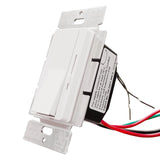
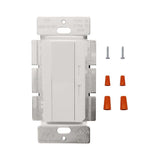


G GJIA 0-10V LED Dimmer Switch
- $29.99
$40.00- $29.99
- Unit price
- per
5% OFF Automatically Applied On Carts Over $299 - 👉Learn More
Subtotal:
$29.99
10 customers are viewing this product
Couldn't load pickup availability
Free Shipping
Free shipping from local warehouses in the US and Canada.
Free Returns
We have a 30-day return policy, which means you have 30 days after receiving your item to request a return.
5 Years Warranty
Warranty duration varies by product. See warranty details for specific terms.
Pack
May ship in different packs than selected. Total quantity guaranteed.
About this item
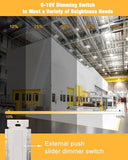
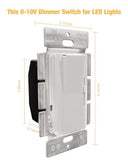
- 【0-10V Full Range Dimming】: G GJIA LED high bay light dimmer switch offers precise control with a large rocker and slider, allowing easy adjustment of brightness levels. The fine-tuning steering wheel ensures flicker-free dimming, providing optimal lighting comfort.
- 【Certification and Warranty】: 0-10V dimmer switch is UL certified, ensuring safety and quality. We offer a 5-year warranty and a 30-day return policy from the date of purchase. If you have any questions, our dedicated team is available to provide excellent after-sales service.
- 【Durable Housing】: This dimmer switch has a rugged thermoplastic housing, offering both durability and aesthetic appeal for seamless integration with your building.
- 【Applicable Products】: Our dimmer switch is compatible with LED High Bay Lights, LED Linear High Bay Lights, and High Wall Pack Lights.
- 【The Scope of Application】: The 1-10V dimmer switch is suitable for use with LED high bay lights with a maximum power rating of 700W.
See more


Description
xBrochures & Spec Sheets
📝0-10V Dimmer switch manual
User Guide
📝What's Led Shop Lights Dimmable

What This Dimmer Does
A 0-10V dimmer switch sends a low-voltage analog control signal (0-10V DC) to compatible LED drivers, instructing the driver how much light output to produce. Unlike traditional triac or leading-edge dimmers that regulate brightness by modifying the AC power waveform, 0-10V dimming is the preferred commercial lighting control standard used in warehouses, offices, retail facilities, schools, manufacturing plants and building automation systems.
Why Choose 0-10V Instead of Triac Dimming?
- Smooth, Flicker-Free Dimming — Dims down to approximately 1% light output, compared to the 10–30% minimum common with triac dimmers.
- No Buzzing or Humming — Eliminates the audible noise often associated with commercial LED fixtures on triac controls.
- Higher Fixture Capacity — One dimmer can typically control 10–20+ fixtures, compared to the limited fixture count supported by many triac dimmers.
- Commercial Industry Standard — Compatible with virtually all commercial LED drivers designed for 0-10V control.
- Building Management System Integration — Easily integrates with occupancy sensors, daylight harvesting systems and centralized building automation controls.
Key Features
Smooth 1–100% Dimming
Adjust light output continuously from approximately 1% to 100% using an analog control signal. The dimming response is smooth and gradual without visible brightness steps, making it ideal for commercial and industrial lighting applications.
Controls Up to 20 Fixtures From One Switch
A single dimmer can typically control up to 20 compatible GGJIA fixtures connected in parallel, including UFO high bays, linear high bays, parking lot lights, wall packs, canopy lights and flat panels. Larger installations can be divided into multiple dimming zones or integrated into a centralized building management system.
Standard Single-Gang Wall Box Installation
Designed to fit standard U.S. single-gang wall boxes using a Decora-style form factor. Installation follows standard commercial wiring practices and can be integrated into both new construction and retrofit projects.
Compatible With All GGJIA 0-10V Fixtures
Works with every GGJIA fixture labeled as 0-10V dimmable, including UFO high bays, linear high bays, parking lot lights, canopy lights, wall packs and LED flat panels.
Also compatible with most third-party commercial LED fixtures utilizing standard 0-10V drivers, including products from Lithonia, Cree, Halco, Philips and many other commercial lighting manufacturers.
Color-Matched to Standard Wall Plates
The white finish blends seamlessly with standard Decora wall plates commonly used in commercial buildings. Additional finish options may be available for projects requiring specific architectural color schemes.
Specifications
| Specification | Value |
|---|---|
| Dimmer Type | 0-10V Analog LED Dimmer |
| Dimming Range | 1%–100% |
| Maximum Fixture Count | Up to 20 Fixtures (Typical) |
| Maximum Connected Load | 600W Typical (Driver Dependent) |
| Operating Voltage | 120–277V AC |
| Sink Current | 2 mA Maximum Per Fixture |
| Color | White (Ivory and Almond Available Upon Request) |
| Wall Box Compatibility | Standard U.S. Single-Gang Box |
| Wire Connections | Line, Load, 0-10V (+ Violet), 0-10V (− Gray), Ground |
| Switch Style | Toggle or Slider (Model Dependent) |
| Driver Compatibility | All Standard 0-10V LED Drivers |
| Certifications | UL Listed, ETL Listed, FCC |
| Warranty | 5 Years |
Installation Steps
Step 1 — Turn Off Power at the Circuit Breaker
Disconnect power before beginning installation. Verify the circuit is de-energized using an approved voltage tester.
Step 2 — Remove the Existing Switch
If replacing a standard on/off switch, remove the wall plate and existing switch assembly. Identify and label the incoming line (hot) conductor and outgoing load conductor before disconnecting wiring.
Step 3 — Connect the Line and Load Conductors
Connect the branch-circuit hot conductor to the dimmer's LINE terminal. Connect the conductor feeding the lighting fixtures to the LOAD terminal. Use appropriately sized copper conductors that match the branch circuit rating.
Step 4 — Connect the 0-10V Control Leads
Connect the violet (+) and gray (−) low-voltage dimming leads from the dimmer to the corresponding 0-10V control leads on the fixture drivers.
For multiple fixtures, connect all violet conductors together and all gray conductors together in parallel throughout the dimming zone.
- Violet → Violet (+)
- Gray → Gray (−)
Step 5 — Connect Equipment Ground
Connect the dimmer's grounding conductor to the branch-circuit equipment grounding conductor according to NEC requirements.
Step 6 — Mount and Test
Install the dimmer into the wall box, secure it with mounting screws and reinstall the wall plate. Restore power and slowly adjust the dimmer through its full range to verify smooth fixture operation.
Typical Wiring Diagram
120-277V Power
      |
      |
   [Dimmer]
    |    |
    |    +---- Violet (+) ----------------+
    |                                     |
    |                                     +---- Fixture 1 Driver
    |                                     |
    |                                     +---- Fixture 2 Driver
    |                                     |
    |                                     +---- Fixture 3 Driver
    |
    +---- Gray (-) -----------------------+
Important Installation Notes
- Installation should be performed by a licensed electrician.
- 0-10V control wiring is typically Class 2 low-voltage wiring and commonly uses 18 AWG violet and gray conductors.
- Low-voltage dimming conductors should be installed in accordance with NEC Article 725.
- Follow local electrical codes regarding conductor separation and enclosure requirements.
- Verify fixture compatibility before installation. Fixtures must be labeled 0-10V dimmable to operate with this control.
Recommended Applications
- LED UFO High Bay Lighting
- LED Linear High Bay Systems
- Parking Lot Lighting
- Commercial Offices
- Retail Stores
- Schools & Universities
- Warehouses & Distribution Centers
- Manufacturing Facilities
- Gymnasiums & Recreation Centers
- Building Management System (BMS) Controlled Lighting
Frequently asked questions
Will this dimmer work with my existing LED fixtures?
How many GGJIA high bays can I dim with this switch?
Does this work with motion sensors?
Does this work as a regular on/off switch?
Will it work with 277V commercial circuits?
Can I install this in a residential garage on a 120V circuit?
What if my fixture isn't dimming smoothly?
Can I install this myself?
Is this compatible with smart home systems?
- Choosing a selection results in a full page refresh.