Loading Dock Lighting Requirements: Light Levels & OSHA Rules
Plan the dock floor, trailer interior and approach as separate lighting tasks before selecting the arm light.
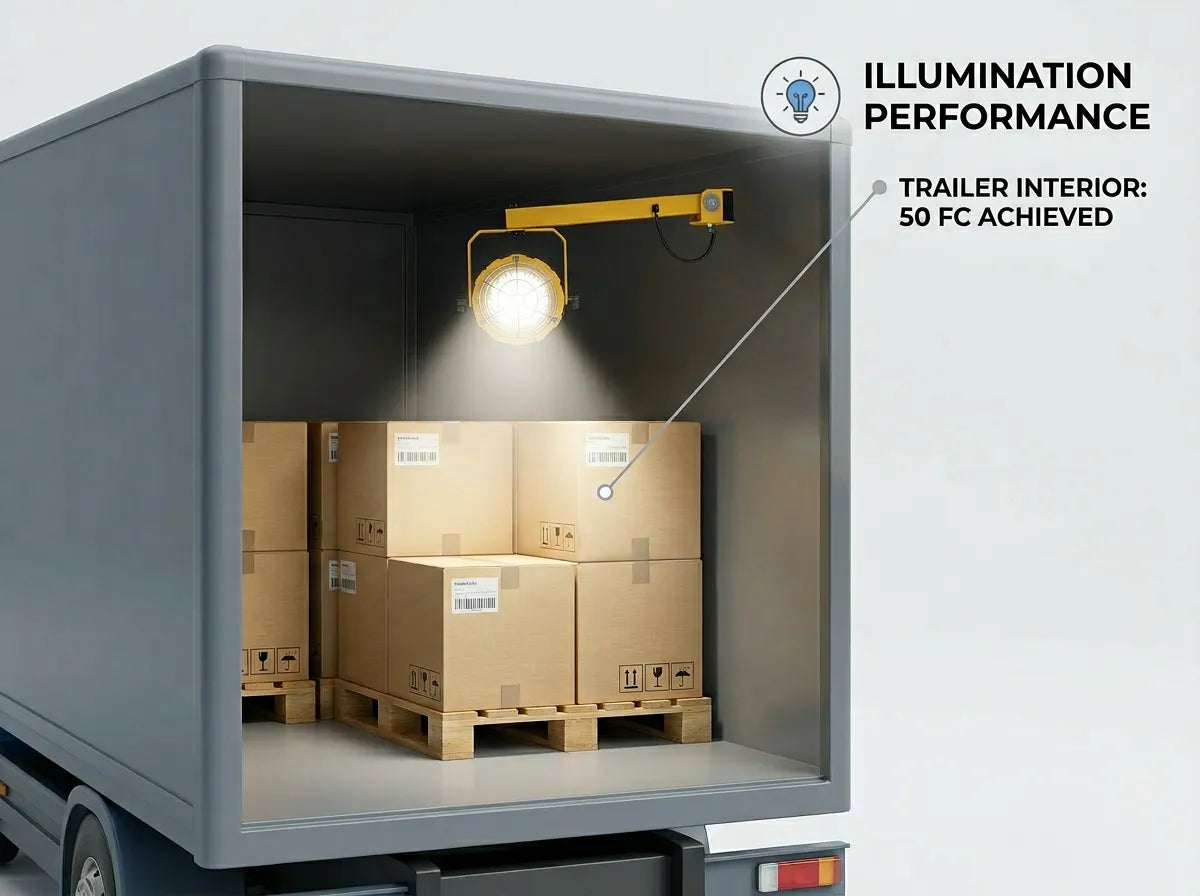
Read the guide →A backed-in trailer blocks overhead light. Use an aimable loading dock light to reach the work inside, while keeping the dock floor and approach covered by their own fixtures. Start with the position of the task and the path of the arm.
Identify the labels, pallets and walking route that need light inside the trailer.
Check the mounting position, usable reach and parked position. Keep the arm clear of doors, vehicles and traffic.
Compare round or square heads and single or double brackets. Confirm the dimensions and power connection of the selected model.
| Decision | Available choices | Selection check |
|---|---|---|
| Lamp head and output | 30W/50W round, 60W round and 30W/50W square options. | Compare the exact series: the listed 30W/50W round outputs are 3,900/6,500 lm; square versions list 4,200/7,000 lm. The 60W round models list 6,600 lm. |
| Arm and connection | Single- and double-bracket configurations. | Check the reach, swing path, stowed position and listed connection. If an arm has an accessory socket, verify its electrical rating before connecting a fan. |
| Lighting task | Trailer interior, dock floor and exterior approach. | Use the arm light for the trailer task. Confirm the full bay layout rather than treating one arm light as the lighting plan for all three areas. Loading Dock Lighting Requirements: Light Levels & OSHA Rules → |
| Exposure | A1/B2 round manuals identify an IP65 lamp head. | Check protection for the selected model and its connection. A lamp-head rating does not establish the protection of the arm socket or site wiring. |
Send the bay and trailer dimensions, mounting location, task photos and available power supply. We can help shortlist the series and review the proposed lighting layout.

Plan the dock floor, trailer interior and approach as separate lighting tasks before selecting the arm light.
Read the guide →Review this earlier dock-lighting overview alongside the more detailed light-level and OSHA guide above.
Read the guide →Learn what color rendering describes when identifying labels, package colors and surface details.
Read the guide →Explore hanging task-light options when the work moves beyond the fixed loading bay.
Read the guide →Review other work-light applications when a fixed dock arm does not fit the task.
Read the guide →Try fixture placement and estimated light levels as an initial planning step before requesting a project layout.
Try the tool →Excludes Alaska and Hawaii. Confirm delivery timing for your project.
Shipping informationKeep the original packaging and contact support before returning an order.
Return conditionsQuestions about your selection? sales@ggjia-led.com
The A1 is a single-arm bracket model — one steel arm extends from the wall and holds the lamp head. The B2 is a double-arm bracket model that features two arms with a built-in electrical socket/receptacle in the middle of the arm assembly. The B2 is ideal when you need to power an accessory (such as a dock fan) directly from the arm without running separate wiring.
Both series come in 30W (3,900 lumens) and 50W (6,500 lumens). Choose 30W for standard trailers, single-bay workbenches, and tasks where a focused spotlight is sufficient. Choose 50W for larger trailers (48–53 ft), wide bays, high-ceiling docks, inspecting goods deep inside a container, or any environment where maximum brightness is needed. If in doubt, the 50W model is the more popular choice in busy distribution centers.
The A1 and B2 Series are certified UL (Underwriters Laboratories), FCC, and RoHS compliant. The lamp head carries an IP65 waterproof rating. UL certification means the product has been tested to North American safety standards — a requirement for commercial installations in the US and Canada. RoHS compliance means it contains no restricted hazardous substances (lead, mercury, cadmium, etc.).
5000K produces a crisp daylight-white light that closely mimics natural sunlight. At a loading dock this means workers can clearly read shipping labels, scan barcodes, check product colors, and identify damage on incoming goods — all tasks that are harder under the warm-yellow light of older HPS or incandescent fixtures. The 5000K output also keeps workers alert during night shifts.
Lumens-per-watt (LM/W) measures how efficiently electricity is converted to light. At 130 LM/W, the GJIA dock light delivers 3,900 lumens from just 30 watts — roughly 5–7 times more efficient than a traditional 150W incandescent dock lamp producing the same light. For a facility running 12 hours per day, switching from a 150W incandescent to the 30W GJIA unit can cut per-bay lighting energy costs by over 80%.
The 30° beam angle concentrates light into a focused, powerful spot rather than spreading it wide. This is intentional for dock lighting: you want the maximum light directed deep into a trailer or container, not scattered up at the ceiling or sideways. The narrow beam ensures high illuminance (foot-candles) where workers actually need it — at the floor, shelving, and rear wall of the truck.
The light mounts to any vertical surface (wall, door frame, dock bumper pillar) using the included bracket. The 5 FT hard-wired power cord is connected to a standard wall outlet or wired directly to a junction box. For hard-wired installations (which is the most common in commercial docks), a licensed electrician or qualified technician should make the electrical connection. Bracket mounting itself requires basic hand tools and takes 15–30 minutes per unit.
The light accepts AC 100–277V, making it compatible with virtually all North American electrical systems — standard 110–120V outlets as well as 208V, 240V, and 277V commercial circuits. No voltage converter is needed anywhere in the US or Canada.
Yes. The B2 double-arm bracket includes a 3-prong receptacle on the arm assembly, allowing you to plug in a standard dock fan (or other accessory) directly. This eliminates the need to run separate wiring or extension cords to the fan. The receptacle is powered whenever the dock light is wired to the circuit.
Yes. The 40″ arm is designed to fold (swing) so the light can be retracted out of the way when a bay is empty or when closing dock doors. The 360° rotatable lamp head also allows the light to be repositioned quickly as trucks of different heights back into the bay.
Most dock lights are mounted between 7 and 9 feet above dock level, typically to the side of the dock door frame. At this height a 40″ arm and 360° rotatable head can angle light both downward into the trailer floor and horizontally across shelving. Your specific mounting height may vary based on dock door height and trailer dimensions — a 40″ arm is suitable for standard 48–53 ft trailers.
No. The dock light includes a built-in on/off switch on the fixture itself for immediate, tool-free operation. Simply flip the switch to control the light independently of any wall switch. Most facilities also wire the light to a wall switch at the dock control panel for convenience.
IP65 means the lamp head is fully dust-tight and protected against water jets from any direction — rain, hose-downs, and pressure washing. For covered loading docks, semi-exposed docks, and outdoor dock aprons in the US and Canada (including wet climates like the Pacific Northwest and cold climates like Canada), IP65 is the minimum recommended rating and fully adequate for most installations.
The stainless steel protective cage surrounds the polycarbonate (PC) lens and is designed to withstand accidental impacts from dock doors, forklifts, and pallet jacks — a common hazard in high-traffic loading environments. The combination of cast aluminum housing, stainless steel cage, and PC lens makes the fixture far more impact-resistant than glass-lens alternatives.
LED technology has no warm-up delay and operates reliably in cold temperatures — a key advantage over metal halide or fluorescent lights that flicker or fail to start below freezing. The fixture is suitable for outdoor and semi-covered environments across all Canadian provinces. Always check the installation manual for the full rated temperature range specific to your unit.
OSHA does not mandate a specific color for dock lights, but safety yellow is the industry standard color that signals "caution" equipment in industrial environments — consistent with OSHA's general color-coding guidance for hazard awareness. The high-visibility yellow color also makes it easy to spot the light arm position in dim or busy dock areas.
Thanks for subscribing!
This email has been registered!
| Product | SKU | Description | Collection | Availability | Product type | Other details |
|---|