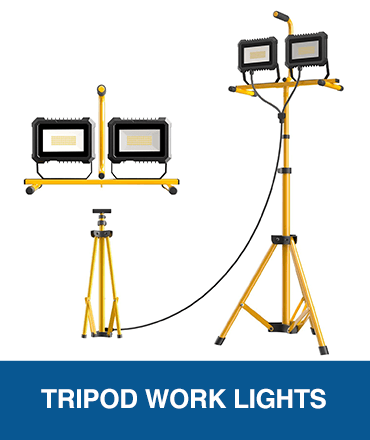
LED Tripod Work Lights


Bring light to changing tasks with GGJIA LED tripod work lights. Choose 80W or 200W dual-head models with AC120V input, adjustable lamp heads and IP65-rated lights. Check the stand position, power route and working distance before choosing the output.

Move the Light to the Work

A portable work light on a tripod lets you change position as the job moves. Plan a stable place for the stand and aim the two heads toward the work without shining into the operator’s view. Keep the power route clear of the task.

Tripod stand and cable placement concept Aim heads toward the workKeep the route clear
Setup concept only. Use the selected model’s dimensions, height limits and installation instructions.

Plan the Stand, the Heads and the Cable

  1. Choose a stable stand position

    Allow room for the spread legs. Keep the stand outside walking paths, vehicle movement and the space needed for tools.

  2. Aim around the task

    Use the adjustable heads to light the work from useful directions. Check the view from where the operator actually stands.

  3. Plan the power route

    These are AC120V corded lights. Confirm the available supply and the connection arrangement for the site; plan where the cable will run.

Compare the Choices Before Ordering

Decision Available choices Selection check
Power and task distance 80W and 200W dual-head models. The 80W model provides 10,000 lm; the 200W model provides 23,000 lm. Compare useful light at the task distance, including aiming and obstructions.
Stand or separate light assembly Foldable tripod and removable light assembly described in the model sheets. Check the supported setup, stable placement and head adjustment before choosing how you will move between jobs.

Advantages of Tripod Work Lights →

Supply and site exposure Both model sheets list AC120V, a 10ft cord and IP65. Check the light, plug and any additional connections for the actual conditions. The fixture rating is not permission to leave connections in standing water.

What Does IP65 Mean? →

Portable or hanging layout A stand occupies floor space; hanging lighting uses a different support arrangement. Choose the format that keeps the work and travel route clear. Confirm each fixture’s intended mounting method.

Portable And Versatile Hanging Construction Lights →

Choose the Tripod Setup for Your Next Task

Send photos of the work area, the working distance, the available supply and how often the lights need to move. We can help compare the two models before you order.

Related Resources

Shipping, Warranty & Returns

Free U.S. & Canada shipping

Excludes Alaska and Hawaii. Confirm delivery timing for your project.

Shipping information

5-year warranty

Review coverage and claim requirements for your order.

Warranty details

Returns for unused items

Keep the original packaging and contact support before returning an order.

Return conditions

Questions about your selection? sales@ggjia-led.com

Recently Viewed Products

Frequently asked questions

  • Q: How do I choose between 80W and 200W?

    The deciding factor is your typical work zone size. For zones under 1,000 sq ft (single garage, small renovation room, vehicle work area), the 80W model produces sufficient illumination at OSHA minimums. For zones over 1,000 sq ft or where you need 30+ footcandle task lighting, the 200W model is appropriate. Cost-wise, the 200W is roughly 2-2.5× the 80W price but produces 2.5× the lumens with significantly more features (telescoping height, longer cord, independent head switching).

  • Q: Can these tripods handle outdoor weather?

    Yes. Both models are IP65 rated for dust and water resistance. They're suitable for outdoor construction in rain, snow and dusty conditions. Do not submerge or expose the power outlet/plug to standing water — IP65 covers the lamp head and tripod, not the cord-to-outlet connection.

  • Q: How tall do the tripods extend?

    The 80W standard model has a fixed-height or short-adjustable tripod (check product page for specific model). The 200W heavy-duty model has a telescoping tripod adjustable from 23.6" to 59" (about 2 to 5 feet), allowing you to position the light at the right height for your specific task.

  • Q: Are the lamp heads adjustable?

    Yes, on both models. Each lamp head can pivot/rotate to direct light where needed. The 200W model offers full 360° horizontal rotation and 180° vertical, making it suitable for almost any aiming configuration. The 80W is more limited but still flexible enough for typical work zones.

  • Q: Can I leave them running for an 8-hour shift?

    Yes. Both models are rated for continuous duty operation. The 50,000-hour L70 lifespan rating assumes continuous use; running 8 hours/day for 5 days/week = ~2,000 hours/year, putting fixture life at 25+ years before LED depreciation begins.

  • Q: Do they work with GFCI outlets on construction sites?

    Yes. Both models work with standard GFCI-protected 120V outlets without nuisance tripping when properly grounded via the 3-prong plug. NEC requires GFCI protection on all construction site temporary power, so this compatibility is essential.

  • Q: What's the warranty?

    Both models carry GGJIA's 5-year ETL-certified warranty. Failures under warranty ship a replacement from Spokane, WA with prepaid return shipping for the defective unit inside the continental U.S. The tripod stand and lamp heads are both covered.

  • Q: Are they brighter than 1000W halogen tripod lights?

    Yes. The 80W produces about 10,000 lumens, comparable to a single 500-800W halogen tripod. The 200W produces 25,000 lumens, brighter than a 1500W halogen tripod and far more energy-efficient (consuming 90%+ less electricity, running 80% cooler, and lasting 50× longer).

  • Q: Can I daisy-chain multiple tripods?

    The 80W standard model is single-plug only (no pass-through). The 200W model has independent per-head switching but is single-plug for the unit. To deploy multiple tripods, plug each into a separate outlet or use surge-protected power strips with GFCI protection. Don't daisy-chain via extension cords beyond 50 ft due to voltage drop.