




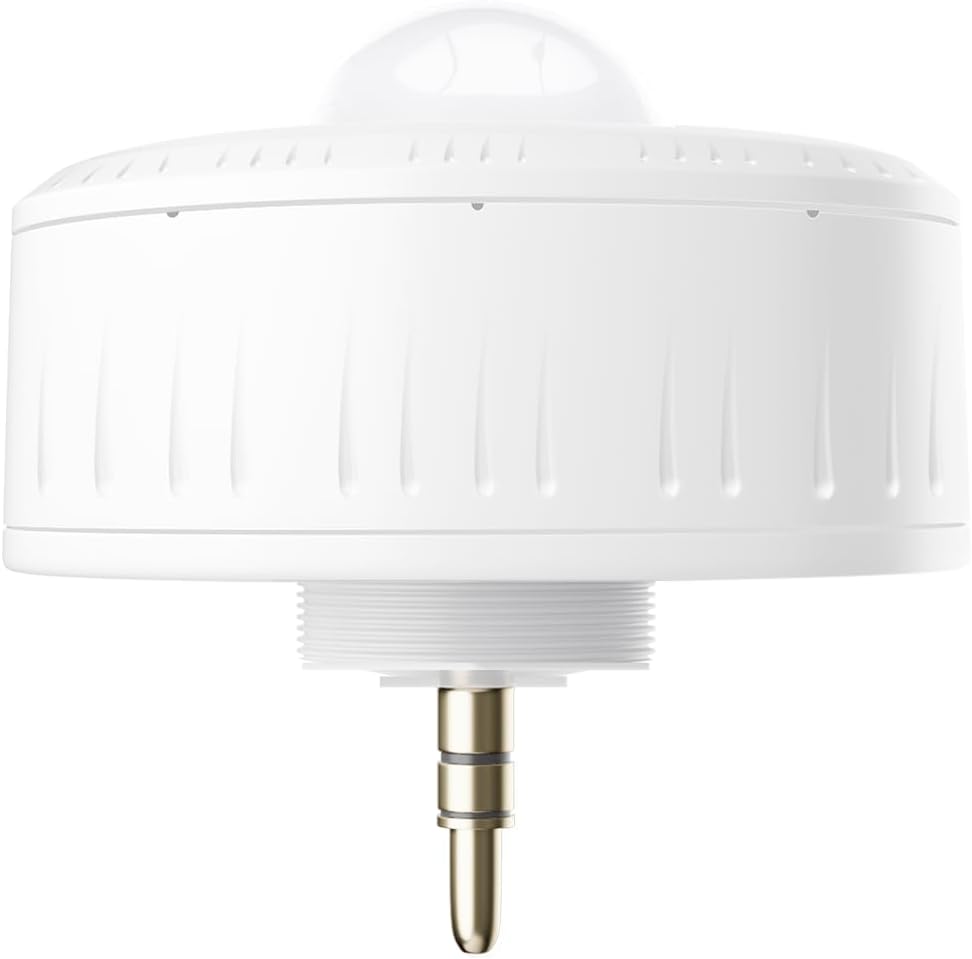







GGJIA 360 Degree PIR Motion Sensor for LED Linear High Bay Light, 40FT Ceiling & 50FT Wall Mount Detection Diameter
- $15.99
$19.99- $15.99
- Unit price
- per
5% OFF Automatically Applied On Carts Over $299 - 👉Learn More
💡Summer Flash Sale 10% OFF
Discount code: SUM10
Copied
Size:
Subtotal:
$15.99
10 customers are viewing this product
Couldn't load pickup availability
Free Shipping
Free shipping from local warehouses in the US and Canada.
Free Returns
We have a 30-day return policy, which means you have 30 days after receiving your item to request a return.
5 Years Warranty
Warranty duration varies by product. See warranty details for specific terms.
Pack
May ship in different packs than selected. Total quantity guaranteed.
About this item
- ✅【Motion Sensor Switch Ceiling Mounted】This sensor employs cutting-edge passive infrared (PIR) technology and microcontroller technology, providing superior stability compared to conventional motion sensors
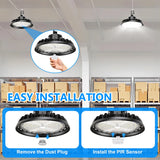
- ✅【Easy to Installation】This PIR Sensor is easy to install, only rotate down the sensor base on base of the LED Linear High Bay light and plug in the sensor and it is ready to use immediately
- ✅【Extend Lamp Life & Energy-Saving】Retains 30% of lumens in standby mode and instantly ramps up to 100% brightness when activated, maximizing energy efficiency and savings, effectively extends the life of the light
- ✅【5-Year Coverage】We support 5-year carranty, we not need charge other fees.Any problem when using our items, please do not hesitate to contact us.
See more


The G GJIA Linear PIR Motion Sensor mounts in an outdoor lighting fixture and provides multi-level control based on motion and/or daylight contribution. It controls 0-10 VDC LED drivers or dimming ballasts, and is rated for wet and cold locations. All control parameters are adjustable via a wireless configuration tool capable of storing.
Applications
• Power supply:
12V-24V DC >30mA
• Dim control output:
0-10V max; 25mA sinking current
• Remote range:
50ft/15ml indoor; no backlight
• Dim control output:
0-10V
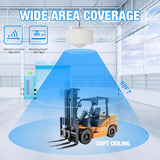
• Detection radius:
20%/50%/75%/100% (1-8m)
• Mounting height:
Max 40ft(12meters)
• Time setting:
10s/1 min/5min/10min/15min/20min/30min/60min
• Light-control:
24H/10 LUX/30 LUX/50 LUX
• Temoerature -40°F ~ +158°F (-40℃ ~ +70℃)
• IP rating IP65
Description
x📝What's Led Shop Lights Dimmable?


What This Sensor Does
A PIR (Passive Infrared) motion sensor detects body heat moving within its coverage area and sends a signal to a compatible LED fixture's 0-10V dimming circuit. When no motion is detected for a configurable period, the fixture automatically dims to a preset standby level (typically 10%). As soon as motion is detected again, the fixture returns to full brightness in approximately one second.
Why add a motion sensor to a commercial LED lighting system?
A standard HID-to-LED retrofit typically reduces lighting energy consumption by approximately 60%. Adding occupancy-based motion sensor control can provide an additional 30–50% energy savings in low-occupancy environments such as warehouses, distribution centers, parking garages, industrial facilities, gym storage rooms and after-hours office spaces.
This means total energy savings can reach 75–85% compared to the original HID lighting system.
For example, at an electricity rate of $0.13/kWh and 4,000 annual operating hours, a 150W LED high bay controlled by a motion sensor can save approximately $28 per fixture annually compared to continuous full-output operation. In a warehouse with 50 fixtures, this can generate approximately $1,400 per year in additional energy savings beyond the LED upgrade itself.
Key Features
30-Foot Detection Range
Detects movement within a 30-ft radius (approximately 60-ft diameter coverage area). For high-ceiling applications, mount the sensor 15–20 ft above the floor. The resulting detection pattern typically covers a 30 × 30 ft work zone.
Configurable Hold Time
Adjust hold time from 30 seconds to 30 minutes using the integrated control dial.
- 5 minutes recommended for active work areas to prevent nuisance dimming.
- 1 minute recommended for low-traffic storage and parking areas to maximize energy savings.
Configurable Standby Level
Adjust standby output from fully off (0%) to 30% brightness.
- 10% standby is the most common commercial setting.
- 30% standby is recommended where security or wayfinding lighting is required.
- 0% standby maximizes energy savings in unoccupied spaces.
Adjustable Sensitivity
Three sensitivity levels allow optimization for specific environments.
- Reduce sensitivity in areas with HVAC airflow, nearby door traffic or other potential false triggers.
- Increase sensitivity for inspection stations, packing benches and areas where occupants remain relatively stationary.
Compatible With All GGJIA 0-10V Fixtures
Connects directly to the same violet (+) and gray (−) 0-10V dimming leads used by standard dimmers.
Compatible with all GGJIA 0-10V dimmable fixtures including:
- UFO High Bay Lights
- Linear High Bay Lights
- Parking Lot Lights
- Wall Pack Lights
- Canopy Lights
- Flat Panel Lights
Wireless Pairing Option Available
The sensor can operate through a traditional hardwired 0-10V connection or via an optional wireless 433 MHz control system.
- New construction: Hardwired installation recommended.
- Retrofit projects: Wireless variant minimizes rewiring requirements.
Specifications
| Specification | Value |
|---|---|
| Sensor Type | PIR (Passive Infrared) |
| Detection Range | 30 ft Radius @ 15-ft Mounting Height |
| Detection Coverage | 360° Ceiling Mount / 180° Wall Mount |
| Hold Time | 30 Seconds – 30 Minutes Adjustable |
| Standby Dim Level | 0% – 30% Adjustable |
| Sensitivity | 3 Adjustable Levels |
| Operating Voltage | 100-277V AC (12V DC Wireless Version Available) |
| Output Signal | 0-10V Analog Dimming Control |
| Operating Temperature | −22°F to 122°F |
| Ingress Protection | IP65 |
| Mounting | Ceiling or Wall Mount, Standard Junction Box |
| Dimensions | 4.0 × 4.0 × 2.5 in |
| Weight | 0.6 lbs |
| Certifications | UL Listed, ETL Listed, FCC, RoHS |
| Warranty | 5 Years |
Installation Steps
Step 1 — Mount the Sensor
Install the sensor on a ceiling or wall depending on the application.
- Ceiling Mount: 360° detection coverage.
- Wall Mount: 180° detection coverage.
- Warehouses & Gyms: Typical mounting height 15–20 ft.
- Garages & Workshops: Typical mounting height 8–10 ft.
Avoid installation directly adjacent to HVAC vents, heaters or exhaust outlets that may cause false activation.
Step 2 — Connect Power
Connect incoming line voltage (100-277V AC), neutral and ground conductors to the sensor input terminals according to the wiring diagram.
No external power supply is required.
Step 3 — Connect the 0-10V Control Leads
Connect the sensor's violet (+) and gray (−) output leads to the corresponding 0-10V dimming leads on the fixture driver.
For multiple fixtures:
- Violet-to-violet connections are daisy-chained throughout the lighting zone.
- Gray-to-gray connections are daisy-chained throughout the lighting zone.
Step 4 — Configure Hold Time and Standby Output
Use the adjustment dials located on the sensor housing to configure:
- Hold Time: 30 seconds to 30 minutes
- Standby Level: 0% to 30%
Factory-recommended starting point:
- 5-minute hold time
- 10% standby level
Fine-tune settings after observing actual occupancy patterns.
Step 5 — Test Detection and Sensitivity
Walk into the monitored area and verify the connected fixtures increase to full output within approximately one second.
After leaving the area and remaining outside the detection zone, verify that fixtures dim to the selected standby level after the configured hold time expires.
If necessary, adjust the sensitivity setting to reduce false triggers or improve motion detection performance.
Frequently asked questions
-
How much energy will the motion sensor save?
Depends heavily on occupancy patterns. Active zones (continuous traffic): 10-20% additional savings. Mixed zones (workers come and go): 30-50% savings. Low-occupancy zones (storage, late-night warehouses, parking lots): 50-70% savings. The math: for a 150W fixture running 4,000 hours/year, a 50% occupancy-rate dimming saves about $80/year per fixture at $0.13/kWh.
-
Can I cover a 60 × 80 ft warehouse with one sensor?
No. The 30-ft detection radius gives roughly 60-ft diameter coverage. For larger zones, use multiple sensors — one per 60-ft section, with sensors networked to control their respective zone of fixtures. For a 60×80 ft warehouse, plan for 2–3 sensors covering different zones.
-
Does it work with my existing GGJIA high bay?
Yes, if the fixture is 0-10V dimmable (every GGJIA linear high bay). Verify by checking the spec sheet for "0-10V dimming" — if it says triac or ELV, the sensor is not compatible.
-
Will it false-trigger from HVAC or traffic outside the room?
PIR sensors are designed to detect body heat changes within their field of view. They don't trigger from sounds, vibrations or motion outside the IR view. However, hot air currents from HVAC vents can cause false triggers — avoid mounting sensors within 6 ft of supply registers. Direct sunlight through windows can also occasionally trigger; orient the sensor away from windows.
-
Can I use this with a wired 0-10V dimmer too?
Yes. A motion sensor and manual dimmer can work together — the sensor turns the fixture on/off based on occupancy, while the dimmer sets the desired brightness when on. Wire both in parallel on the same 0-10V circuit. The dimmer setting acts as the upper limit (e.g., dimmer at 60% = fixture ramps to 60% on motion, dims to standby when no motion).
-
Is there a wireless version?
Yes. The wireless variant (separate SKU, contact sales@ggjia-led.com) uses a 433 MHz wireless signal to communicate with fixture-side receivers, eliminating the need to run 0-10V wiring between sensor and fixtures. Best for retrofit installations where running new wiring is expensive.
-
How do I set the hold time?
Locate the small dial on the back of the sensor labeled "HOLD" or "TIME". Rotate to the desired hold time (30 seconds at minimum, 30 minutes at maximum). For active work zones, 5–10 minutes is typical. For storage and low-occupancy zones, 1–2 minutes maximizes savings.
-
Can I bypass the sensor and run the fixture at 100% always?
Yes. Wire the fixture's 0-10V leads directly to a manual switch or 0-10V dimmer instead of the motion sensor. The fixture operates normally on/off via the manual switch, and the motion sensor can be added later if desired.
-
What's the warranty on the motion sensor?
5 years full replacement, same as all GGJIA accessories. Failures under warranty are replaced with a new sensor shipped from Spokane, WA with prepaid return shipping inside the continental U.S.
- Choosing a selection results in a full page refresh.