





How many high bay lights do I need?
The Fallacy of Wattage: Why Lumens Matter
Many facility managers fall into the trap of “watt-for-watt” replacement—simply swapping a 400W Metal Halide fixture for a 400W LED. This approach often results in either over-illuminating the space (wasting CapEx) or under-illuminating it (causing safety hazards).
Modern LED high bay fixtures range in efficiency from130 to 180 lumens per watt (lm/W). This is a massive variance. A budget fixture rated at 130 lm/W requires significantly more wattage to achieve the same output as a premium fixture operating at 170 lm/W. While the premium fixture has a higher upfront cost, it offers superior ROI through reduced lifetime energy consumption.
Expert Recommendation:Stop looking at watts. Start looking atLumen OutputandSystem Efficacy.
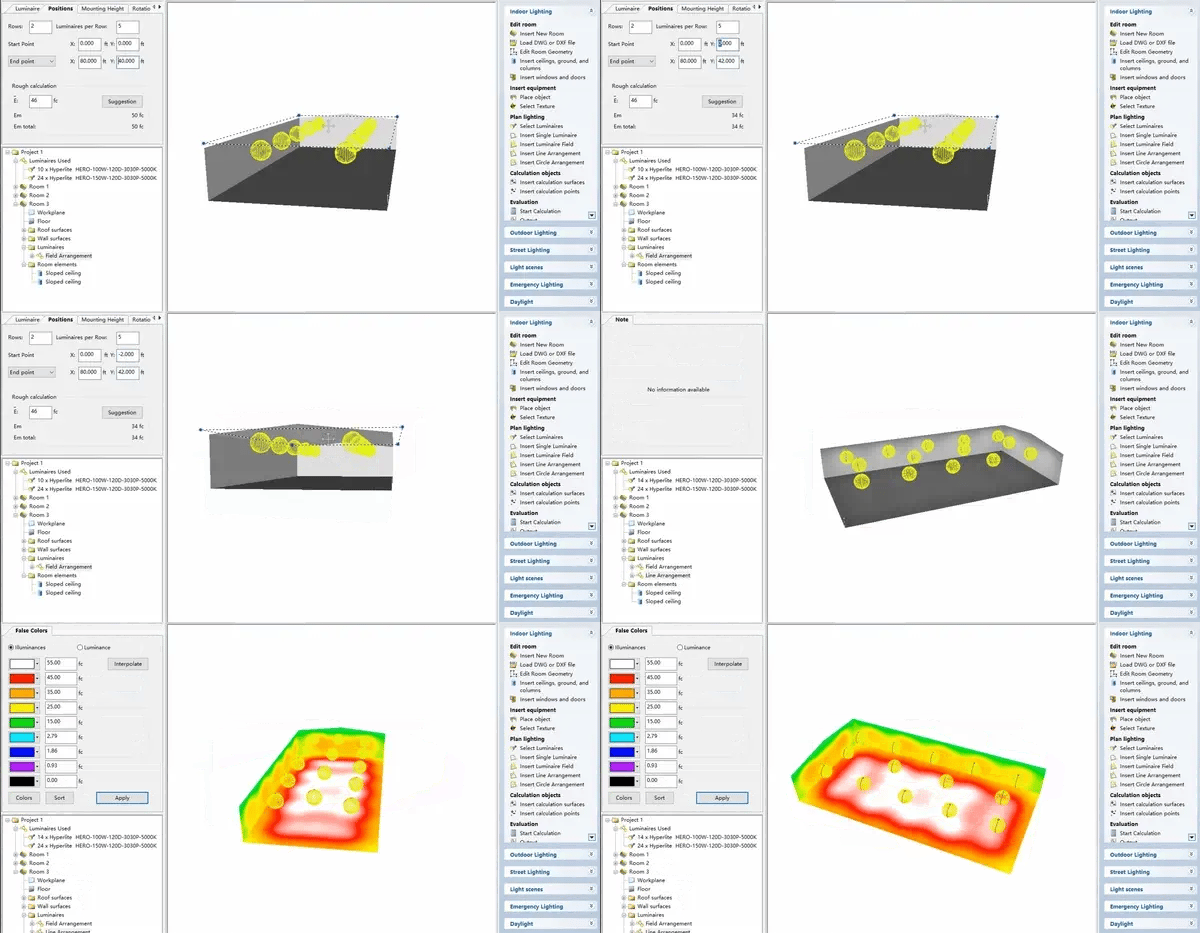
Step 1: Define Your Target Foot-Candles
Before you use any calculator, you must define the required illuminance level for your application, measured infoot-candles (fc). Different industrial environments have vastly different requirements. Below is the benchmark for Canadian industrial environments based on IES standards.
Application Type |
Target Foot-Candles |
Design Lumens (Incl. LLF) |
|---|---|---|
Basic Storage |
30 fc |
375,000 - 450,000 Total Lumens |
Active Warehouse |
50 fc |
625,000 - 750,000 Total Lumens |
Manufacturing |
75 fc |
937,000 - 1,100,000 Total Lumens |
Detail/Inspection |
100 fc |
1,250,000 - 1,500,000 Total Lumens |
Workshop |
50-75 fc |
625,000 - 937,000 Total Lumens |
⚠️ Critical Expert Advice for Contractors:
You must use the“with LLF” (Light Loss Factor)column for your specifications, not the raw initial lumens. Many contractors learn this the hard way when a client complains about dim lighting two years after installation because the maintenance factor wasn’t built into the original design. Always account for depreciation in your calculation.
Step 2: Using the LED High Bay Wattage Calculator
Once you have your total lumen requirement, you can match the fixture size to your application. This is whereLED efficiency ratingsdictate your power consumption.
Use the table below to select the correct wattage based on your ceiling height and the efficiency tier of the fixtures you are specifying.
LED High Bay Wattage Selection Guide
Space / Ceiling Height |
Lumens Needed Per Fixture |
130 lm/W (Standard) |
150 lm/W (Efficient) |
170 lm/W (Premium) |
|---|---|---|---|---|
15 ft (Basic Storage) |
15,000 - 20,000 |
115-155W |
100-135W |
90-120W |
20 ft (Warehouse) |
25,000 - 30,000 |
190-230W |
165-200W |
145-175W |
25 ft (Industrial) |
30,000 - 40,000 |
230-310W |
200-265W |
175-235W |
30 ft (Heavy Duty) |
40,000 - 50,000 |
310-385W |
265-335W |
235-295W |
35 ft+ (Extreme) |
50,000 - 65,000 |
385-500W |
335-435W |
295-385W |
Practical Calculation Example:
Let’s calculate the requirements for a smaller space scenario:
A 2,000 sq ft workshop at 50 foot-candles needs about125,000-150,000 total lumensincluding the light loss factor.
If you plan to install 8 fixtures in this space, each fixture needs to deliver roughly 16,000–19,000 lumens. According to the table, premium 150 lm/W fixtures would require about110W-130Wper unit.
Step 3: Industrial Environment Considerations
An industrial LED lighting calculator must account for variables that simply don’t exist in a clean, dry warehouse. A generic calculator fails if it ignores the environment.
1. Vibration Resistance
Heavy machinery creates constant vibration, which destroys traditional lighting with filaments or glass components.
- Solution:Specify fixtures withsolid-state LED driversrated for high vibration. No glass, no filaments. This is the domain where LED technology completely dominates traditional solutions.
2. IP Rating & Washdown Environments
Airborne particulates (dust) and liquid cleaning drastically reduce fixture output over time.
- Wet Areas:MinimumIP65rating is required.
- Washdown/Food Processing:RequiresIP66 or IP67. Your industrial lighting layout calculator should flag specific areas requiring higher ingress protection to prevent failure.
3. Temperature Extremes
Industrial spaces in Canada face extreme temperature swings.
- Range:From-40°Cin cold storage to+60°Cnear foundry furnaces.
- Verification:Always verify that the driver’s operating temperature range covers your actual conditions. Cheaper drivers often fail or experience significant light loss in extreme cold.
Validating Your Layout: The Final Check
Calculations are theoretical; validation is practical. To ensure your project succeeds and meets ROI targets:
- Measure:Get precise dimensions of the floor area and ceiling height.
- Target:Identify your foot-candle goal based on the task being performed.
- Factor In:Always include the Light Loss Factor (LLF) in your total lumen calculation.
- Compliance:Validate your layout againstIES (Illuminating Engineering Society)standards to ensure uniformity and glare control.
Why Choose G GJIA for Your Industrial Lighting?
Once you have your calculations, you need a supply partner who understands the technical demands of industrial applications. We provide a full range ofCSA-certifiedandDLC-listedLED high bay fixtures, including both UFO high bays and linear high bays.
- Power Range:100W to 500W.
- Coverage:Ceiling heights from 15 to 40+ feet.
- Durability:Built to perform in rugged Canadian conditions, from -40°C cold storage to high-heat industrial environments.
We don’t just sell fixtures; we provide thephotometric dataandlayout supportyou need to ensure your design translates perfectly to the installed reality.
Ready to Optimize Your Facility?
Don’t leave your lighting to guesswork. Whether you are retrofitting a maintenance shop or illuminating a heavy-duty manufacturing floor, accurate wattage calculation is the key to long-term savings and safety.
Get Your Free Photometric Layout Plan Today
Download Our Industrial LED Specification Sheet