



AT A GLANCE
If you manage a warehouse, factory, or large commercial space, your lighting bill is likely one of your largest and most persistent operational costs. You’re caught between the need for bright, safe, uniform illumination and the pressure to reduce energy consumption and maintenance headaches. The flicker of old metal halide fixtures and the constant hum of outdated HPS lamps are more than just annoyances—they’re signs of money leaking from your bottom line. This guide will cut through the technical jargon to show you not just why modern LED high bays are a superior choice, but how to evaluate them, with a specific engineering analysis of a high-value option like the GJIA 210W Linear High Bay Light.
On this page
The Real Cost of Sticking with Traditional Industrial Lighting
The true expense of industrial lighting goes far beyond the monthly utility bill. It’s a combination of wasted energy, relentless maintenance cycles, and hidden risks.
Energy Consumption Analysis: The Silent Budget Drain
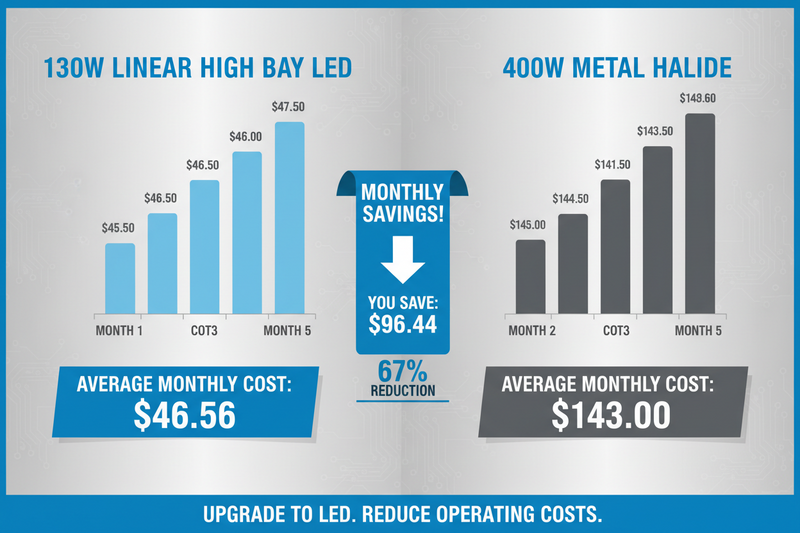
Traditional High-Pressure Sodium (HPS) or Metal Halide (MH) fixtures are incredibly inefficient. Where a modern LED like the GJIA 210W achieves an efficacy of 150 lumens per watt, a typical 400W HPS fixture might only manage 100 lm/W, producing less light while using almost double the energy. For a facility with 100 fixtures running 12 hours a day, this inefficiency can translate to tens of thousands of dollars in unnecessary annual electricity costs.
Maintenance & Replacement Hidden Costs
The short lifespan of traditional bulbs (10,000-20,000 hours) means frequent relamping. Factor in the labor cost for a certified electrician to work at height, the downtime for the area being serviced, and the inventory cost of keeping spare bulbs on hand. This recurring expense is virtually eliminated with LEDs boasting 50,000+ hour lifespans and minimal lumen depreciation.
Safety & Compliance Risks
Poor lighting creates shadows and dark spots, increasing the risk of accidents and injuries. Furthermore, outdated fixtures may not meet current OSHA standards for illuminance levels in work areas. Flickering lights and long warm-up times (common with HPS/MH) also contribute to eye strain and reduced worker alertness.
OSHA standard 1910.333(a) mandates adequate lighting for all working areas, a benchmark where consistent, instant-on LED lighting excels.

Technical Deep Dive: What Makes Industrial LEDs Different
Not all LEDs are created equal, especially for the demanding environment of an industrial facility.
Photometrics Explained: Lumens, Lux, and Efficacy
- Lumens measure total light output (e.g., the GJIA 210W produces 31,500 lumens).
- Lux measures light intensity on a surface (lumens per square meter). Proper layout ensures adequate lux levels for tasks.
- Efficacy (lm/W) is the efficiency score. The GJIA’s 150 lm/W rating is a DLC Premium-tier efficiency, meaning maximum light for minimum wattage.
IP Ratings Decoded: What IP65 Really Means for Your Facility
Ingress Protection (IP) ratings define resistance to solids and liquids. For dusty warehouses or environments with occasional washdowns, a high IP rating is crucial. While specific IP ratings should be verified per model, industrial-grade fixtures are typically built to withstand such conditions.
Thermal Management: The Key to 50,000+ Hour Lifespan
Heat is the enemy of LED longevity. Superior fixtures use materials like aerospace-grade aluminum (as found in the GJIA 210W) and intelligent ventilated designs to passively dissipate heat, ensuring stable performance and fulfilling the promised lifespan with minimal light loss (<2% depreciation @50,000 hrs).

GJIA 210W Linear High Bay Light: An Engineering Analysis
Let’s apply the technical criteria to a specific, high-value product: the GJIA 210W 31,500LM Linear High Bay LED Shop Light.
Precision Optics & Uniformity
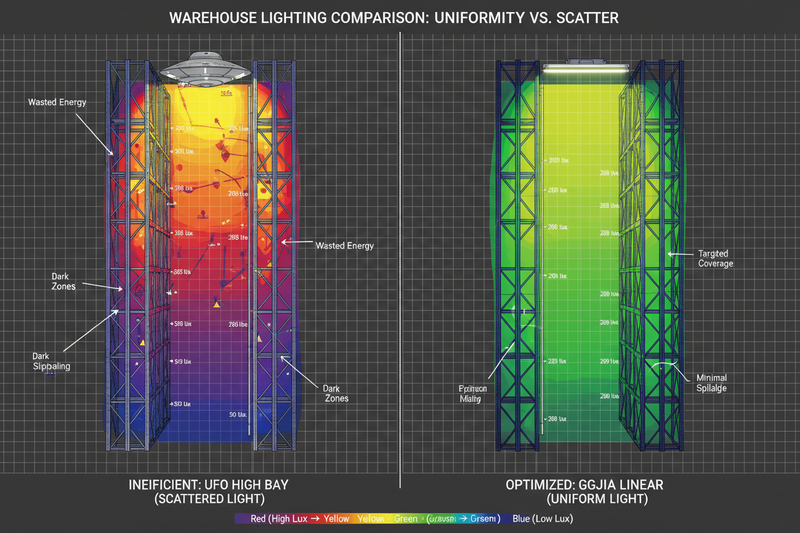
This fixture features a 90° beam angle, which is ideal for providing wide, even coverage from a high mounting height, reducing the “spotlight” effect and minimizing dark aisles between fixtures. The linear design itself promotes uniform light distribution across long aisles in warehouses or workshops.
Robust Construction for Harsh Environments
Constructed with an aerospace-grade aluminum housing, this fixture is built for durability. The slim, lightweight (6 lbs) profile reduces stress on mounting points, and the overall design is engineered for the vibrations and temperature swings common in industrial settings.
Smart Control Compatibility & Future-Proofing
As a 0-10V dimmable light, it seamlessly integrates with building management systems (BMS), occupancy sensors, and daylight harvesting controls. The noted compatibility with a PIR motion sensor allows for automatic dimming to 30% when areas are unoccupied, unlocking further energy savings. Its universal 120-277V input simplifies installation in any commercial electrical system.
The UL/CUL listing is a critical certification, providing independent verification of safety standards for use in factories, warehouses, and workshops.

Head-to-Head Comparison: GJIA 210W vs. Traditional Alternatives
| Feature | GJIA 210W LED Linear High Bay | Traditional 400W Metal Halide | Standard LED High Bay (Entry-Level) |
|---|---|---|---|
| Light Output | 31,500 Lumens | ~36,000 Lumens (after warm-up) | ~28,000 Lumens |
| Power Consumption | 210W (90W when dimmed) | 455W (incl. ballast) | 210W |
| Efficacy | 150 lm/W (DLC Premium) | ~79 lm/W | ~133 lm/W |
| Lifespan | 50,000+ hours | 10,000-15,000 hours | 35,000-50,000 hours |
| Startup Time | Instant Full Brightness | 5-10 minute warm-up | Instant Full Brightness |
| Dimmability | Yes (0-10V, 10%-100%) | No | Sometimes (Optional) |
| Warranty | 5 Years | 1 Year (on bulb only) | 3-5 Years |
Key Takeaway: The GJIA 210W matches or exceeds the useful light output of a 400W MH while using less than half the energy, offering instant control, and backed by a significantly longer warranty.
ROI Calculation: The Numbers Don’t Lie
Let’s model a simple payback scenario for a small warehouse replacing 50 old 400W MH fixtures.
- Assumptions: 12 hrs/day, 6 days/week, $0.12/kWh electricity rate.
- Old System (400W MH): 50 fixtures * 0.455 kW * 3,744 hrs/yr * $0.12 = $10,221/year
- New System (GJIA 210W): 50 fixtures * 0.21 kW * 3,744 hrs/yr * $0.12 = $4,717/year
- Annual Energy Savings: $5,504
- Project Cost (Est.): 50 fixtures * $78.99 + installation = ~$5,500
- Simple Payback Period: ~12 months.
Adding savings from eliminated relamping (2-3 bulb changes over MH lifespan) and reduced cooling loads (LEDs emit far less radiant heat), the total ROI becomes even more compelling.
“After switching to linear LEDs similar to the GJIA model, our distribution center cut its lighting energy use by 62%. The improved light quality also reduced picking errors.” – Facility Manager, Mid-West Logistics Co.

Implementation Guide & Best Practices
Retrofit vs. New Installation
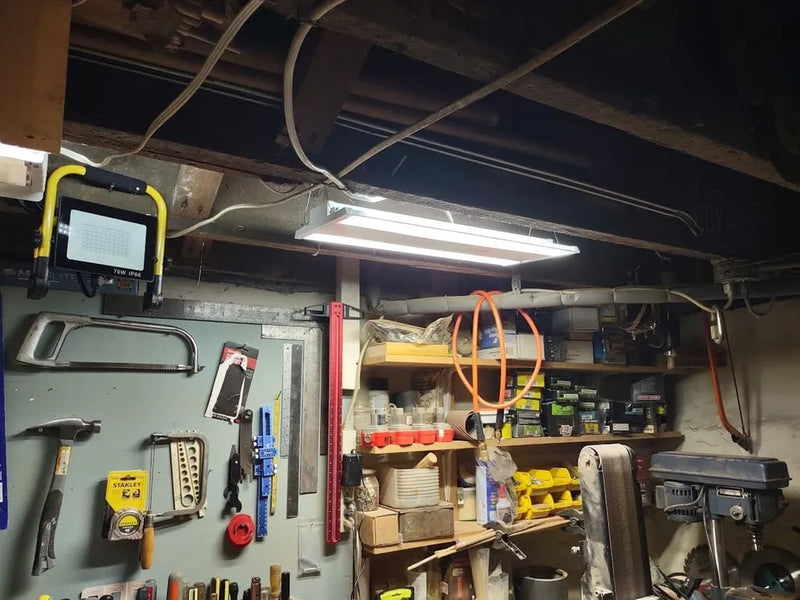
This GJIA light is designed for easy retrofit. Its lightweight design allows for one-person installation, often using existing wiring and mounting points from old fixtures. The included suspension chain kit offers flexible height adjustment.
Lighting Layout Optimization
For uniform illumination, spacing between fixtures should generally not exceed 1.5 times the mounting height. With a 90° beam angle and 20ft mounting height, aim for spacing around 30ft apart. Always consult a lighting layout tool or professional for precise plans.
Maintenance Schedule
One of the biggest benefits: minimal maintenance. Simply plan for periodic cleaning of lenses to maintain light output and a visual inspection of mounts every few years. The 50,000-hour rating means over a decade of operation at typical use.
Frequently Asked Questions (FAQ)
Q1: How long do industrial LEDs like the GJIA 210W actually last?
A: With proper thermal management, high-quality industrial LEDs are rated for 50,000 to 100,000 hours of operation. The GJIA 210W is engineered for a 50,000-hour lifespan with less than 2% lumen depreciation, equating to over 10 years of use at 12 hours per day.
Q2: What is the ROI of LED warehouse lighting?
A: ROI typically ranges from 1-3 years, depending on utility rates and hours of operation. As shown in our calculation, savings of 50-80% on lighting energy costs are common, leading to a very fast payback.
Q3: Are LED high bays worth the investment?
A: Absolutely. Beyond energy savings, the benefits include improved worker safety and productivity due to better light quality, zero maintenance costs for years, reduced HVAC load, and compliance with modern energy codes.
Q4: Do I need to buy a separate dimmer or sensor for the GJIA 210W?
A: Yes, the 0-10V dimmer and PIR motion sensor are sold separately, giving you the flexibility to choose controls that fit your specific system and needs.
Q5: What does “0-10V dimmable” mean?
A: It’s a standard analog protocol for lighting controls. A low-voltage signal (0-10 volts) from a compatible dimmer or sensor tells the driver to adjust the light output from 10% to 100%.

Q6: Can this light be used in a damp or dusty location?
A: You should verify the specific IP rating for your application. Industrial-grade fixtures like this are built for harsh environments, but always check the product specifications for the exact dust and moisture ingress protection level.
Q7: What is the color temperature (4000K/5000K adjustable)?
A: This fixture offers two choices: 4000K (neutral white) is often preferred for general warehousing, while 5000K (cool white) is brighter and more stimulating, ideal for detailed assembly or inspection areas. The adjustability allows you to choose per zone.
Q8: Is professional installation required?
A: While designed for easier installation, any electrical work, especially at height in an industrial setting, should be performed by a qualified electrician to ensure safety and compliance with local codes.
Beyond the Product: Additional Resources
- Internal Links: [Link to related blog on Lighting Controls], [Link to Warehouse Lighting Case Study]
- Downloadable Resources: [Download the GJIA 210W Technical Spec Sheet], [Link to DLC Qualified Products List]
- Video Demonstrations: [Watch a 2-minute installation video of the GJIA high bay]
- Tips: For further reading on standards, refer to the Illuminating Engineering Society (IES) and DesignLights Consortium (DLC).
Ready to Illuminate Your Savings?
Get Your Instant ROI Calculation: Speak with our lighting specialists to model your exact savings.
Download the Full Technical Spec Sheet: See all the engineering details for the GJIA 210W Linear High Bay.
Schedule a Free, No-Obligation Lighting Audit: Call us at (346) 490-6412 or click below.
Buy the GJIA 210W Linear High Bay LED Light Now – $78.99
Have questions? Our team is available via live chat or phone to discuss your project specifics.
Find the right light for your space.
Explore GGJIA lighting, compare your options, and get help with your next project.
JOIN THE CONVERSATION
Leave a comment
READER DISCUSSION
Discussion
No comments yet. Be the first to share your thoughts.