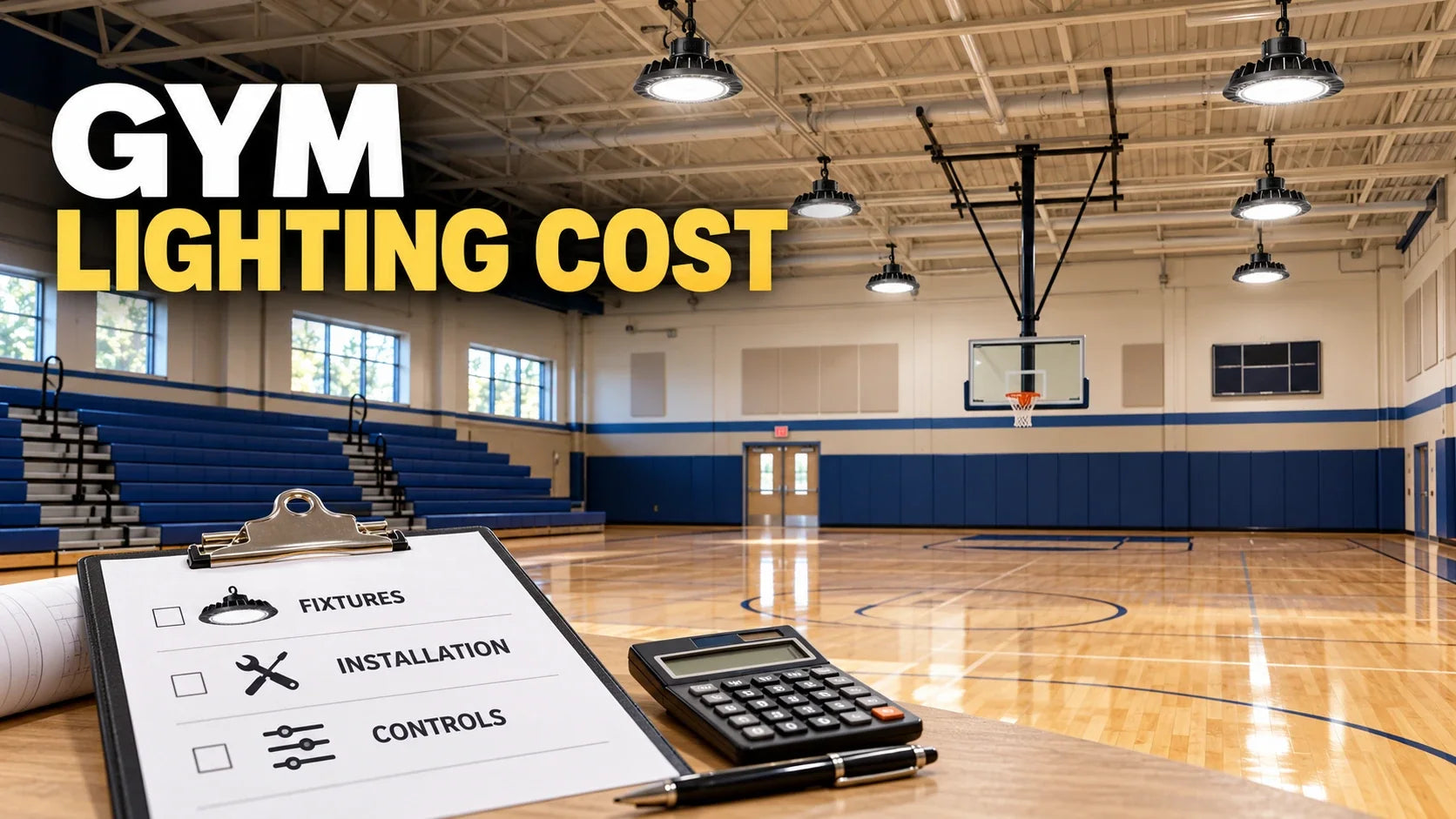
Gymnasium LED Lighting Cost: Fixture Prices, Installation, and Quote Comparison
Compare fixture prices, installation and control costs before setting your project budget.
Read the article →Compare LED gymnasium lighting around the activities, mounting height and player viewing angles. Linear and UFO high bays offer different installation choices; review stadium fixtures separately for the intended sports space.
Planning sketch: confirm fixture count and spacing with a project layout.
Record court dimensions, mounting height, roof obstructions and existing wiring points. Include how the room is used for play, practice and events.
Review fixture placement, dark areas and the directions players look. An enclosure impact rating alone does not confirm suitability above an indoor court.
Compare 0–10V dimmable high bays and the exact sensor configuration. Confirm low-light operation and how the lights switch fully off for events.
| Decision | Available features | Selection check |
|---|---|---|
| Fixture format | Linear and UFO high bays; stadium options need a project review. | Compare the layout, glare, fixing arrangement and any ball-impact requirements. |
| Controls | 0–10V dimmable high-bay options. | Choose a compatible control and confirm sensor inclusion separately. |
| Project cost | Fixture, mounting, controls, labor and access equipment. | Compare a complete installed scope instead of fixture prices alone. |
Review available fixtures above, or send your project details for selection and pricing help.
Compare gymnasium lighting cost across fixtures, installation access and controls. GGJIA offers free photometric layouts for any project size; share your court dimensions, mounting height and activity to start.

Compare fixture prices, installation and control costs before setting your project budget.
Read the article →Compare UFO high bay options for your mounting and control requirements.
Explore the collection →Explore linear high bays for your fixture layout and project shortlist.
Explore the collection →Review the DLC collection, then confirm model-specific eligibility for your project.
Explore the collection →Estimate fixture requirements from room dimensions and mounting height as a planning starting point.
Try the tool →Try fixture placement and compare estimated illuminance and power before deciding on a layout.
Try the tool →Excludes Alaska and Hawaii. Confirm delivery timing for your project.
Shipping informationKeep the original packaging and contact support before returning an order.
Return conditionsQuestions about your selection? sales@ggjia-led.com
Compare the fixture and its light distribution with the court layout, rather than choosing by shape alone. Linear high bays have an elongated body; UFO high bays have a compact round body. Either format needs an appropriate mounting arrangement and a layout that checks useful light across the court and the views of players looking upward. Compare the proposed fixture’s photometric data, controls and service access. A linear shape alone does not guarantee lower glare than a UFO fixture.
Determine quantity through a layout using the court dimensions, mounting height and activities, not a fixed watts-per-room rule. Set the target for the applicable competition or facility brief, then review average light level, uniformity and glare together. For context, FIBA venue guidance gives average horizontal levels of at least 300 lux for community recreation and 750 lux for non-broadcast competition or elite practice; these are not blanket U.S. school requirements. Send your dimensions and intended use for a free GGJIA photometric layout.
Do not choose an LED replacement by matching the old lamp’s wattage or trusting a replacement-equivalent label alone. Record the existing lamp and fixture, actual system input, mounting height and layout, then compare the proposed LED fixture’s delivered light distribution and controls. Replacing the complete fixture also requires a mounting, wiring and access plan. Keep the required court-lighting outcome in the comparison; a lower wattage is useful only if the proposed installation still meets that brief.
No single collection label establishes suitability above every court. Start by comparing the indoor high-bay options. Stadium fixtures need a project-specific review of mounting, distribution, glare and sports use; parking-lot fixtures should be assessed for the entrance or parking area rather than assumed to be indoor court substitutes. Where balls can strike a fixture, request the exact model’s impact or sports-use documentation and any approved guard. An enclosure IK rating alone does not establish the suitability of the whole installation.
Yes, if the selected fixture has a dimmable driver and a compatible control system. A 0–10V fixture needs a matching 0–10V control arrangement; an existing household phase-cut dimmer is not automatically suitable. Confirm the driver’s minimum light level and how the lights switch fully off, because some systems need a separate switching function. Test the proposed fixture and control before buying the full quantity, especially when low light levels are important.
Compare the same lighting brief and a complete installed scope. Include fixtures, mounting parts, controls, installation labor, access equipment, removal and disposal, and any electrical changes. Estimate running cost from actual system watts, quantity and operating hours. Treat a rebate as conditional until the exact model and your utility’s rules are confirmed; a DLC listing alone does not guarantee payment. Send the room dimensions, mounting height, current fixtures and required activities so quotes can be compared on the same basis.
Compare gym lighting project costs — See how fixture, installation and access costs affect a complete project budget.
Thanks for subscribing!
This email has been registered!
| Product | SKU | Description | Collection | Availability | Product type | Other details |
|---|