





AT A GLANCE
Data from leading operational consultants reveals a striking trend: facilities that strategically upgrade their lighting, viewing it not as a utility but as a distributed sensory network and human performance platform, see an average increase of 2-5% in Overall Equipment Effectiveness (OEE). The old conversation ended at kilowatt-hours. The new one begins with human visual performance, operational resilience, and strategic readiness. With over 15 years of engineering and deploying lighting solutions in harsh industrial environments, we’ve witnessed this transformation firsthand.
This guide will reframe your approach, moving from simple product replacement to a holistic performance upgrade, using adaptable solutions like the G GJIA 60W 4FT LED Vapor Light;as a foundational component of a smarter system.
On this page
The Hidden Costs of Outdated Industrial Lighting
The true expense of poor lighting extends far beyond the electricity meter. It’s embedded in your quality control, workforce safety, and strategic agility.
Visual Error and Product Quality
Insufficient or inconsistent lighting is a direct contributor to visual fatigue and error. On assembly lines or quality inspection stations, poor contrast and shadows can lead to missed defects, increased scrap rates, and costly rework. A study by the Illuminating Engineering Society (IES) directly links proper illumination levels and uniformity to reduced error rates in visual task performance.

Employee Safety, Fatigue, and Insurance Implications
The National Institute for Occupational Safety and Health (NIOSH) has published research correlating suboptimal lighting with increased workplace accidents due to reduced depth perception and heightened reaction times. Furthermore, insurers like FM Global recognize robust, well-maintained systems as a key risk mitigation factor. Upgrading to high-performance, durable fixtures can positively influence risk assessments and, consequently, insurance premiums.
The “Future-Proof” Risk: Locked Out of IoT Integration
Legacy lighting systems are dead ends in the data-driven future of Industry 4.0. They cannot integrate with building management systems (BMS), occupancy sensors, or data networks. This creates “islands of darkness” in your facility’s operational intelligence and locks you into a static, inefficient model. A modern lighting system should be a ready platform for future integration.
The Three-Pillar Framework for Modern Industrial Lighting
Forget “watts and lumens.” A strategic upgrade is built on three interdependent pillars.
Pillar 1: Foundational Resilience & Compliance
This is the non-negotiable base. Lighting must withstand the environment—washdowns, chemical exposure, vibration, and impact. This isn’t a feature; it’s a prerequisite for reliable operation.Example in Practice:TheG GJIA Vapor Tight Lightembodies this with itsIP65-rated, fully gasketed polycarbonate enclosure. This ensures reliable operation in food processing, parking garages, or coolers, forming a dependable physical layer for any system.

Pillar 2: Human-Centric Visual Performance
Light influences circadian rhythms, alertness, and visual acuity. The goal is to match the light to the task and the human.
- Visual Task Rating (per IESNA RP-7):Precision assembly requires high, uniform illuminance (~1000 lux) and excellent color rendering (CRI >90). Warehouse aisles need lower, well-distributed light for safe navigation. A one-size-fits-all approach fails here.
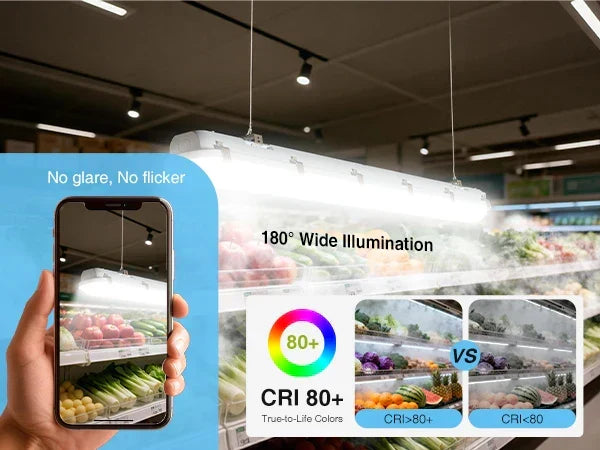
- Human-Centric Lighting (HCL):Adjustable Correlated Color Temperature (CCT) allows you to tune the light. A cooler 5000K light can boost alertness in daytime assembly areas, while a warmer 3000K light may be better for break rooms. Flicker-free operation is critical to reducing eye strain and headaches.
- Product Integration:TheG GJIA fixture’s field-selectable CCT (3000K-6500K)and itspremium-grade, flicker-free driverare not just specs—they are the tools that allow you to implement HCL principles and meet precise visual task requirements, directly impacting worker comfort and precision.

Pillar 3: Adaptive Intelligence & Data Readiness
The lighting system should be a future-proof grid. It must be capable of evolving from simple illumination to a network that provides data on space utilization, environmental conditions, and energy granularity.
- The Smart-Ready Platform:This means fixtures with standard, interoperable interfaces (like 0-10V dimming or DALI-2) that can easily connect to sensors and network gateways.
- Product Integration:A fixture like theG GJIA, with itsrobust construction and 50,000+ hour lifespan, is the perfect, long-life physical carrier for future smart components. Its standard design ensures it won’t become obsolete, protecting your capital investment. Choosing a “smart-ready” fixture today is a low-cost hedge against tomorrow’s mandatory upgrades.
Engineering Analysis: The G GJIA 60W Vapor Light as a Strategic Enabler
Let’s examine how a specific product aligns with the three-pillar framework, serving as a versatile building block.
Configurability for Tailored Solutions
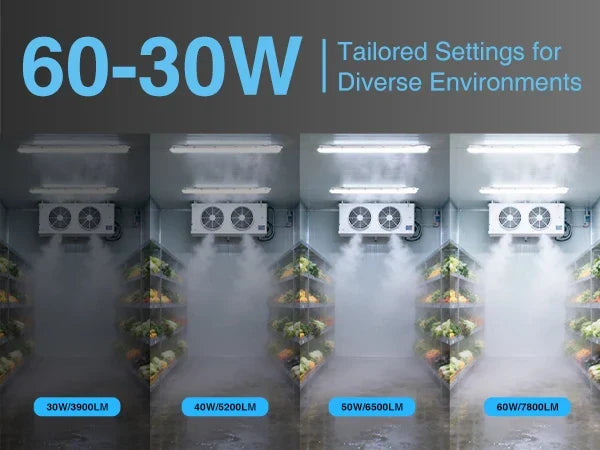
Thefield-selectable wattage (30W/40W/50W/60W) and CCTmean one SKU can be deployed across multiple zones—a high-bay storage area, a wet processing room, and an office annex—each tuned to its specific need. This simplifies procurement, inventory, and maintenance while delivering tailored performance.
Built for the Demanding Real World
Thehigh-durability PC housing and diffuseroffer superior impact resistance and thermal management, directly supporting Pillar 1 (Resilience). TheETL certification and 5-year warrantyare not just checkboxes; they are signals of verified safety, quality, and long-term reliability that financial decision-makers require.

The Bridge to a Smarter System
The fixture’s design accommodatesemergency battery backups and sensor modules. This explicitly positions it as part of Pillar 3 (Adaptive Intelligence), a node on your future network, not a terminal point.
Frequently Asked Questions (FAQ)
Q1: Is the ROI on lighting upgrades still just about energy savings?
A:No. While energy savings (often 40-60%) provide the fast payback, the primary ROI for modern systems comes from enhanced operational performance: reduced quality defects, lower injury rates, improved employee retention, and the avoided cost of a separate future IoT infrastructure upgrade.
Q2: What does “human-centric lighting” mean in a practical, industrial sense?
A:Practically, it means using light to support the task and the worker. It involves providing the right amount and quality of light (high CRI, flicker-free) at the right location and, where beneficial, using tunable CCT to align with work patterns to reduce fatigue in critical visual task areas.
Q3: How do I know if my facility needs an IP65-rated fixture like the G GJIA?
A:Any environment subject to moisture, dust, high-pressure washdowns, or corrosive airborne particles requires a sealed fixture. This includes food & beverage plants, automotive wash bays, wastewater treatment facilities, parking structures, and refrigerated storage. IP65 is a minimum standard for true resilience in these areas.
Q4: Can I integrate these lights with my existing building management system?
A:The G GJIA fixture is a robust, “smart-ready” platform. Its standard design allows for the addition of compatible sensors and control modules. For full BMS integration, you would typically add a network of these sensors connected via a gateway to your BMS, using the fixtures as the reliable light source. We can advise on compatible control ecosystems.
Q5: What’s involved in a retrofit vs. a new installation?
A:A retrofit often uses existing wiring and mounting points, making it faster and less disruptive. The G GJIA comes with versatile mounting hardware for surface or suspended installation, facilitating both. A new installation allows for a completely optimized layout from scratch.

Q6: How is the 50,000-hour lifespan calculated, and what does it mean for me?
A:This is the L70 rating, meaning the LEDs are projected to output at least 70% of their initial lumens at 50,000 hours of operation under defined conditions. For a facility running 24/7, this translates to over 5.5 years of continuous use before significant light degradation, drastically reducing replacement labor and material costs.
Q7: Are there incentives or rebates available for this type of upgrade?
A:Many utility companies and local/state governments offer significant rebates for energy-efficient LED upgrades. The specific value depends on your location and the projected kWh savings. We can often provide documentation to support your rebate application.
Q8: What kind of after-sales support can we expect?
A:The G GJIA is backed by a5-year hassle-free warrantyand is supported by our technical team. We provide detailed spec sheets, CAD files for planning, and direct access to specialists who understand industrial applications.
Beyond the Product: Your Strategic Resources
- Internal Link:Calculating TCO for Industrial LED Upgrades: A Spreadsheet Model
- Downloadable Resource:G GJIA 60W Vapor Light Detailed Technical Specification Sheet & IES File
- Industry Authority Links:Illuminating Engineering Society (IES), National Electrical Manufacturers Association (NEMA), DesignLights Consortium (DLC) Qualified Products List.
Ready to Move from Assessment to Action?
This isn’t about buying a light bulb. It’s about launching a targeted initiative to boost operational efficiency, mitigate risk, and build a smarter facility. Let’s translate this framework into your specific context.
Schedule Your Comprehensive Lighting Audit & Phased ROI Plan with a Specialist
Go beyond a simple quote. Our 90-minute audit and planning session will map your facility against the Three-Pillar Framework, identify quick wins, and model a multi-phase TCO/ROI.
Download Detailed G GJIA Specs & CAD Files for Your Engineering Team
Provide your engineers with all the technical data they need for layout planning and integration analysis.
Have an immediate question? Call our industrial lighting specialists at: (346) 490-6412
Find the right light for your space.
Explore GGJIA lighting, compare your options, and get help with your next project.
JOIN THE CONVERSATION
Leave a comment
READER DISCUSSION
Discussion
No comments yet. Be the first to share your thoughts.