





AT A GLANCE
Key Takeaways
- 1,000W MH → 300W LED: GGJIA's reference produces 42,000 lumens with 70% less rated power at the same hours, excluding the old ballast.
- Replacement references: 400W MH → 150W LED; 600W MH → 200W LED; 1,000W MH → 300W LED; 1,200–1,500W MH → 400W LED. Match coverage to your lot.
- 20-light electricity example: assumed 1,100W old systems → 300W LEDs, 4,000 hours/year and $0.13/kWh saves 64,000 kWh and $8,320 a year.
- Rebates reduce upfront cost: the example assumes $150 per fixture, or $3,000 total. Use the approved local amount; obtain preapproval when required.
- Example payback: about 1.2–2.1 years, with an assumed $15,000–$25,000 installed budget, $3,000 rebate and $2,000/year net maintenance savings, plus electricity savings.
- Beyond the bill: instant-on light, site-matched coverage, good color rendering, compatible dimming and no routine MH bulb relamping. Include old-lamp recycling in the job.
On this page
Why Convert Your Parking Lot from Metal Halide to LED?
Imagine the last customers heading to their cars while you make a note to replace another parking lot lamp. The bulb is only part of the job: someone has to arrange the electrician, the lift and a time that works around the business. If your lot still runs metal halide (MH) or high-pressure sodium (HPS), lighting costs show up in four places: electricity, relamping labor, replacement bulbs and ballasts, and the work of keeping dim or failed lights from disrupting the lot.
A metal halide to LED parking lot conversion addresses both the bill and that maintenance routine. The useful question is not “How do I keep the same wattage?” It's “How do I get the light my parking spaces need with less power?” GGJIA's 300W LED, rated at 42,000 lumens, is its replacement reference for a 1,000W MH lamp. Here's how to choose a replacement and work out what the switch could save.
What LED Wattage Replaces My Metal Halide?
Watts describe power use; lumens describe light output. For a 400W MH lamp, GGJIA's replacement reference is a 150W LED producing 21,000 lumens—not a new 400W LED. Start with that reference, then match the light pattern to your lot. The metal halide to LED conversion chart below covers the four linked adjustable-arm models:
| Your Metal Halide / HPS Lamp | LED Replacement Reference | LED Lumens | Rated-Power Reduction* |
|---|---|---|---|
| 400W MH/HPS | 150W LED | 21,000 lm | 62.5% |
| 600W MH/HPS | 200W LED | 28,000 lm | 66.7% |
| 1,000W MH/HPS | 300W LED | 42,000 lm | 70.0% |
| 1,200–1,500W MH/HPS | 400W LED | 56,000 lm | 66.7–73.3% |
*Calculated as (old lamp watts − LED watts) ÷ old lamp watts, with the same operating hours and excluding the old ballast. These manufacturer replacement references help shortlist a fixture; the final choice depends on coverage, pole positions and the light your site needs.
The bulb's wattage isn't the whole electricity bill. A metal halide lamp also needs a ballast—the component that regulates its electricity. Use the complete old system's input from its label or manufacturer data when calculating savings. In the example below, we assume a 1,000W lamp and ballast draw 1,100W together. Switching to 300W LED cuts the input by 800W per fixture.
Why light output is only part of the choice: picture two fixtures with the same lumen output. One puts most of its light close to the pole; the other spreads more along the parking row. The lumen number matches, but the spaces between poles receive different amounts of light. The optics—the parts that shape the beam—make that difference.
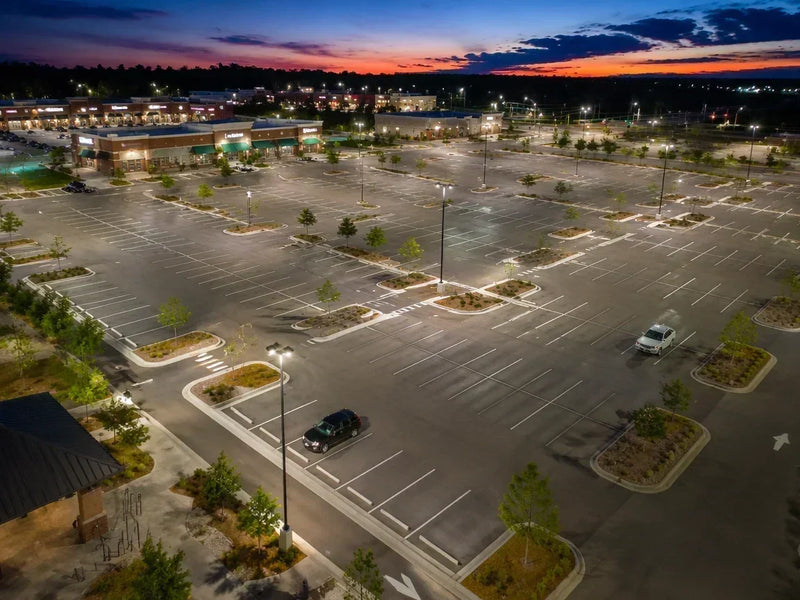
You want useful light along the route from the entrance to the car, not just bright pavement beneath a pole. A photometric layout is a map of predicted light levels: it shows how the proposed fixtures work with your pole heights and spacing. For more on wattage, mounting and controls, see our parking lot light selection guide.
From Your Old Lamp to an LED Shortlist: Four Steps
- Record what you have. Note the old lamp type and wattage. For the electricity calculation, obtain the complete lamp-and-ballast system's input watts.
- Shortlist an LED replacement. Use the chart above as a starting point, then compare lumen output and light distribution.
- Check the installation. Record pole heights and spacing, supply voltage and mounting connections so the proposed fixture fits the site.
- Check the proposed lighting. Use a photometric layout to review coverage, light levels and uniformity across parking spaces, drive aisles and walking routes against the project targets. Our parking lot photometric layout guide introduces the design steps.
Retrofit Kit vs Full Fixture Replacement
Do you need a new light source inside the old housing, or a completely new head on the pole? The condition of what you already own is a useful place to start.
Retrofit Kit (reuse existing housing)
A compatible kit installs an LED light source and associated components inside your existing housing. If the housing, lens, seals and mounting hardware are sound, reusing them may be worthwhile. The kit must be designed for that fixture; its instructions determine the changes to the old lamp and ballast.
You're keeping more than a metal box: you're keeping its remaining condition and light pattern. Compare the proposed coverage and installed cost so the equipment you retain still earns its place in the upgrade.
Full Fixture Replacement (new LED shoebox)
Full replacement gives you a new head with the LED source, driver, optics and housing designed together. It makes sense when the old head is corroded, its lens or seals are damaged, a compatible kit is unavailable, or you want to update the light distribution and controls together.
Compare what it costs to get each option working on your poles. The kit or fixture price is only the start. Include labor, lift access, mounting parts, electrical work, old-lamp recycling and warranty coverage in both quotes. A lower parts price is useful only if the complete job—and the equipment left afterward—offers good value.
Photos of the equipment labels and mounts, your fixture count, pole heights and supply voltage give the electrician and supplier a practical starting point. The linked 150W, 200W and 300W models have 100–277V and 277–480V variants; the linked 400W model lists 100–277V. A qualified electrician should match the installation to the actual fixture and circuit.
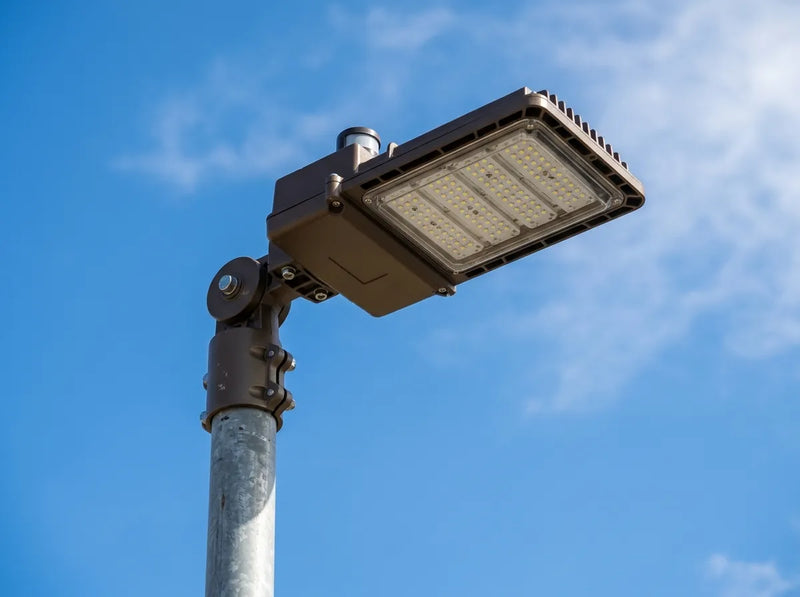
Considering complete fixtures? GGJIA's adjustable-arm models in the chart include a dusk-to-dawn photocell, 0–10V dimming, IP66 housing and a 180° adjustable arm mount. See the parking lot light collection. If you're keeping your pole positions, send us the site dimensions and pole locations for a free photometric layout for any project size.
What Will You Save? A 20-Light ROI Example
ROI means return on investment. For this upgrade, start with two practical questions: how much will you save each year, and how long will those savings take to cover the job?
Let's use an illustrative 20-fixture commercial parking lot switching from 1,000W metal halide lamps to 300W LEDs. Assume each old lamp-and-ballast system draws 1,100W, both installations run 4,000 hours a year, and electricity costs $0.13/kWh. That gives an annual electricity saving of $8,320, before adding any maintenance savings.
Energy Savings
Per fixture: 1,100W − 300W = 800W saved
20 fixtures × 800W = 16,000W = 16 kW reduction
Operating hours: 4,000 hours/year
Energy saved: 16 kW × 4,000 hours = 64,000 kWh/year
At $0.13/kWh: 64,000 × $0.13 = $8,320/year saved
A kilowatt-hour (kWh) is the unit of energy billed here. In this example, the old lights use 88,000 kWh a year and the LEDs use 24,000 kWh: about 72.7% less lighting energy at the same hours. You're paying to run the same number of lights for the same time, but each one draws less power.
For your lot: annual energy savings = fixture count × (old system watts − LED watts) ÷ 1,000 × annual hours. Multiply the result by your $/kWh rate. If the light count or schedule changes, calculate the old and new totals separately, then subtract. This covers usage-based electricity costs, not every charge on the bill.
Maintenance Savings
Suppose a lamp at the entrance fails. The replacement bulb is one expense; arranging the electrician, lift access and a work window adds the rest. Those visits are why maintenance belongs in the calculation—not just on the to-do list.
LED removes routine MH bulb relamping from the schedule. Use your bulb, ballast, labor and lift records to estimate the avoided expense, then subtract the new installation's maintenance budget. Here, we'll assume $2,000 a year in net maintenance savings; your own records provide the figure for your property.
Utility Rebates
A rebate means less money to recover after installation. Our example assumes $150 per fixture × 20 = $3,000. It's a calculation input, not a current utility offer; use the amount your local program approves for your job.
Payback Calculation
Total annual savings: $8,320 (electricity) + $2,000 (assumed net maintenance) = $10,320/year
Assumed installed project cost: $15,000–$25,000
Less assumed rebates: $3,000
Net upfront cost: $12,000–$22,000
Simple payback: $12,000–$22,000 ÷ $10,320/year = about 1.2–2.1 years
Simple payback is the net upfront cost divided by annual savings. Think of the lower bills and avoided maintenance costs gradually recovering the money spent on the upgrade. In this example, they cover the assumed investment in about 1.2–2.1 years; the budget is illustrative, not a market price or a quote.
Longer operating hours give each watt saved more time to lower the bill. A rebate reduces the amount you need to recover. To estimate your payback, start with the installed quote and electricity savings, then add record-based maintenance savings and an approved rebate. This quick calculation leaves out financing, taxes and future price changes.
How to Claim Your Utility Rebate
Make the first call before placing the order. Ask your utility: “Does this project qualify, which fixtures are accepted, and do I need approval before I buy?” Then follow its sequence:
- Find the local program. Use your utility's official commercial lighting rebate page or give its energy-efficiency team the property location and proposed upgrade.
- Get preapproval when required. Establish the purchase, installation and application deadlines before committing to the job.
- Match the proposed product. All GGJIA commercial parking lot fixtures are DLC qualified. DLC means DesignLights Consortium; match the exact product's listing information to the program's accepted criteria.
- Keep the paperwork as you go. Save the requested specification sheets, qualification information, itemized invoice and installation records. Submit by the deadline and follow the program's payment schedule.
The utility sets the eligible amount and project conditions. If you need help identifying relevant programs or obtaining GGJIA product documentation, email support@ggjia-led.com with your project location and proposed fixtures.
Beyond the Bill: What You'll Notice After the Switch
The savings matter. So does what happens when you open the business, walk to your car or arrange the next maintenance visit:
- Light when you switch it on. At opening time, LED reaches full output without a lamp warm-up. After a power interruption, that same instant-on behavior applies when power returns.
- Light along the route people use. The entrance, curb and spaces between poles deserve attention—not just the pavement directly under a light. Matching optics and aiming to the layout helps put light along that route. See parking lot lighting requirements by property type for what to prioritize at your property.
- Colors that look familiar. Good color rendering helps a red jacket look red, rather than merely making it brighter. Choose that quality alongside coverage and glare; camera-equipped lots also need lighting suited to the camera system.
- Less full-power lighting after closing. Most spaces may be empty while employees still need the route to their cars. Compatible 0–10V controls let you lower output for quieter hours; automatic schedules or motion response need additional compatible controls. The built-in photocell handles dusk-to-dawn switching.
- One less recurring bulb-replacement job. Moving away from MH lamps removes their routine relamping and the associated lamp collection. Arrange recycling for the old mercury-containing lamps with the initial installation, so their disposal doesn't become a separate job afterward.
Ready to Convert Your Parking Lot?
Gather the old equipment labels, fixture count, operating hours and electricity rate, then get a complete installed quote. You'll have the inputs to choose a replacement and estimate when the savings cover the upgrade.
GGJIA's linked parking lot fixtures carry a 5-year warranty. We offer free photometric layouts for any project size to help connect your fixture choice to the light your site needs.
Request a Free Photometric Layout →
Related Reading
- How to Choose the Right LED Parking Lot Lights →
- Parking Lot Lighting Requirements by Property Type →
Sources
Frequently asked questions
What size LED replaces a 1000W metal halide parking lot light?
What replaces a 400W metal halide parking lot light?
How much does it cost to convert a parking lot to LED?
What's the payback period for a parking lot LED retrofit?
Should I use a retrofit kit or replace the whole fixture?
Do LED parking lot lights qualify for utility rebates?
How much energy does converting to LED actually save?
Find the right light for your space.
Explore GGJIA lighting, compare your options, and get help with your next project.
JOIN THE CONVERSATION
Leave a comment
READER DISCUSSION
Discussion
No comments yet. Be the first to share your thoughts.