





AT A GLANCE
Key Takeaways
- Find your property's reference: ordinary open parking is 1.0 fc suburban / 1.5 fc urban, maintained average, in LDL's 2013 guide.
- Retail, hospital and school parking: Germantown's published references are 1–2 fc maintained average; multifamily and industrial employee parking are 0.5–1.0 fc.
- Separate vehicle displays: LDL's 2013 exterior-sales references are 15 fc suburban / 20 fc urban, not ordinary customer-parking targets.
- Transit has a different measure: Madison's medium-activity example is 0.4 fc minimum and 2.5 fc maximum average.
- Check dark gaps: look at the lowest reading as well as the average. Germantown's 4:1 low-activity / 3:1 medium-high references are average-to-minimum ratios.
- Follow the people: prioritize entrance routes, crossings and drop-offs; control glare and light reaching nearby windows.
- Before ordering: confirm local criteria, pole height and spacing, voltage and operating hours, then get a photometric layout. These published examples are not nationwide legal limits.
On this page
How bright should your parking lot be? Find your property type in the table below, then check the walk from a parking space to the entrance. The useful answer includes both: enough light on the pavement and a clear route through the lot.
This guide covers eight types of outdoor parking, from office buildings to transit stops. You will find published foot-candle references, the places to prioritize and a short checklist to use before ordering lights.
How Much Light Does Your Parking Lot Need?
Foot-candles (fc) measure light reaching a surface. For a parking lot, think of the light on the pavement, rather than the lumens printed on the fixture box. In the table, average describes the overall level; minimum is the lowest reading. “Maintained” allows for light loss as fixtures age and get dirty.
| Property type | Published reference | Where to focus |
|---|---|---|
| 1. Office / general commercial | 1.0 fc suburban / 1.5 fc urban, maintained average for medium-activity open parking. LDL, 2013. | Parking rows and the walk to the building |
| 2. Retail / shopping center | 1–2 fc, maintained average for community shopping centers. Germantown guidelines. | Store entrances, crossings and cart-return routes |
| 3. Auto dealership | 15 fc suburban / 20 fc urban, maintained average for exterior sales lots. LDL, 2013. | Vehicle displays, separate from customer parking |
| 4. Multifamily / apartments | 0.5–1.0 fc, maintained average. Germantown guidelines. | The walk home and nearby residential windows |
| 5. Medical / hospital campus | 1–2 fc, maintained average for hospital parking. Germantown guidelines. | Accessible spaces, entrance routes and drop-offs |
| 6. School / educational | 1–2 fc, maintained average for educational facilities. Germantown guidelines. | Evening entrances and overflow-parking routes |
| 7. Industrial / warehouse yard | 0.5–1.0 fc, maintained average for industrial employee parking. Germantown guidelines. | Employee parking, with loading tasks evaluated separately |
| 8. Park & ride / transit | 0.4 fc minimum; 2.5 fc maximum average for medium-activity parking/pedestrian areas. Madison local example. | The route from parked cars to stops and waiting areas |
Use these numbers to understand the scale, then confirm the requirements for your address. They are historical or local examples, not one nationwide legal table. For transit, 2.5 fc is an average ceiling, not a minimum to achieve.
Eight Property Types: What Should You Prioritize?
1. Office / General Commercial: Light the Walk to the Door
Keep parking rows, crossings and the entrance route evenly lit. The table's 1.0 / 1.5 fc office reference helps frame the overall level; the gaps between poles still need attention. Picture an employee leaving late: can they see the curb, the island and the space between two parked cars?
A dusk-to-dawn photocell switches lights with daylight. For after-hours dimming, keep the routes used by late-shift employees and cleaners illuminated until they leave.

2. Retail / Shopping Center: Follow the Shopper, Not Just the Cars
Prioritize the route between the storefront and the parking spaces. Germantown's 1–2 fc reference is for community shopping centers. Give crossings, cart returns and curbs particular attention: customers carrying bags or pushing carts need to see the path ahead.
A bright entrance followed by a dark stretch is a poor experience. Check coverage along the whole route, and control glare in the directions people and cameras look.

3. Auto Dealership: Separate Displays from Customer Parking
Plan vehicle displays and ordinary parking as different areas. The 15 / 20 fc references in the 2013 guide apply to exterior sales lots. They help explain why a display row may call for more light than a place where customers simply park.
Review how the light falls on vehicle sides and paint, not only the pavement. Color rendering affects how finishes appear; color temperature describes the light's white tone. Check reflections and keep the route to the showroom clear.

4. Multifamily / Apartments: Make the Walk Home Clear
Light the parking spaces and entry paths while keeping light away from bedroom windows. Germantown's 0.5–1.0 fc reference is for multifamily parking. Put useful light on the route residents actually take, including steps and changes in level.
At the residential edge, use suitable light direction and shielding before adding output. Review the view from nearby windows. If you dim overnight, retain enough coverage for residents arriving late.

5. Medical / Hospital Campus: Make Arrival Easy to Navigate
Prioritize accessible spaces, patient drop-offs and the path to the entrance. The 1–2 fc hospital-parking reference gives a starting scale. Visitors may be unfamiliar with the site, so check curbs, crossings and the gaps between the car and the door.
For a 24-hour facility, review the routes people use overnight before reducing light levels. Check required emergency and exit lighting separately so the plan also addresses a power outage.

6. School / Educational: Check the Lot During Evening Events
Include the walk from overflow parking, not just the spaces nearest the building. Germantown's educational-facility reference is 1–2 fc maintained average. Think through dismissal, sports nights and evening meetings, when people may use entrances that are quiet during the day.
Match schedules to actual event hours. Inspect routes near trees and check that growing branches, maintenance access and nearby activity have been considered when placing fixtures.

7. Industrial / Warehouse: Keep Parking and Work Areas Separate
Evaluate employee parking separately from loading docks and active truck areas. Germantown's 0.5–1.0 fc reference applies to industrial employee parking. Reading labels, handling goods and working around trailers are different tasks that need their own lighting assessment.
Check the site with tall vehicles in their usual positions; trailers can block light that reaches an empty yard. Before selecting fixtures, confirm the supply voltage and the existing mounting arrangement.

8. Park & Ride / Transit: Light the Whole Passenger Route
Follow the passenger from the car to the stop or platform. Madison's medium-activity example specifies 0.4 fc minimum and a 2.5 fc maximum average. Check crossings, waiting areas and ticket machines as well as the parking rows.
Set operating hours around the first and last services, including delayed arrivals. If transit funding or project specifications add requirements, include those in the layout brief.

The Lot Looks Bright, but Some Spaces Are Dark. What Should You Check?
Start with a walk after dark, with the lights in their normal operating mode. From the parking spaces people actually use, follow the route to the entrance. Look for curbs that disappear into shadow, dark stretches between poles and walking routes blocked from the light by trees or parked vehicles. Mark those places on a site sketch. These are useful warning signs, not a measurement of whether the lot meets its lighting requirements.
Next, check the numbers at those locations. Ask for the minimum reading as well as the average in a photometric layout—a map of predicted light levels—or have the existing lot measured with a light meter using the project's measurement method. A bright patch beneath a pole can raise the average while leaving the next parking row too dim.
For a concrete reference, Germantown's guidelines use 4:1 average-to-minimum for low activity and 3:1 for medium/high activity. In an assumed example, 2 fc average divided by 0.5 fc minimum equals 4:1. That gives you a simple way to read a proposal.
Some reports also show maximum-to-minimum. Keep the label with the number: it is a different comparison. For a dark gap, check fixture direction, pole positions and obstructions before buying higher-wattage lights. If a tree blocks the beam, more output from the same position may leave the same area in shadow.
A simple check: mark the hard-to-see areas → compare their readings with the project's criteria → review direction, spacing and obstructions before adding power.
How High Should the Poles Be, and How Far Apart?
For a retrofit, measure the existing mounting height and pole spacing first. A DOE example from 2008 records 20–30 ft for typical 400W metal-halide parking lighting. That is a useful reference for an older lot, not a required height for every LED project.
The spacing needs its own check. PNNL's 2011 study describes existing lots spaced around four times the mounting height or more; a specific LDL LED layout from 2015 uses 25 ft mounting height and 50 ft spacing. Those examples are different because the fixtures and layouts are different. Test the proposed model at your actual pole positions and check the lowest readings between poles.
Keeping the poles? Use their measured height and positions to compare replacement fixtures. Adding new poles? Confirm the local height limit, then select height, spacing and light distribution together.
How Do You Keep the Lot Useful Without Lighting Up the Neighbors?
Keep Light on the Parking Area
Start with the direction of the light and shielding at the boundary. Check nearby windows, not just the view from under the fixture. A BUG rating describes Backlight, Uplight and Glare; U0 is the lowest uplight category. The IES / IDA Model Lighting Ordinance ties permitted ratings to the lighting zone and fixture position, so choose the rating for the intended location and aiming angle.
For a numeric local example, Smithfield Township, Pennsylvania, limits light projected onto residential use or permanent open space to 0.1 initial fc, measured line-of-sight from any point on the receiving residential property. Obtain your address's limit and measurement method before finalizing boundary fixtures.
Choose the White-Light Appearance
4000K looks less cool; 5000K has a cooler, daylight-like appearance. Where both are allowed, compare them with the surrounding lights and the view from nearby homes. This describes the white-light appearance, not how much light reaches the pavement.
Check warm-light requirements before buying. For example, the DarkSky commercial luminaire program sets a nominal maximum of 3000K alongside other criteria. That applies to the program, not every parking lot nationwide.
What Should You Check Before Ordering Fixtures?
- Electrical and mounting fit: match the site's supply voltage, pole or wall mounting and outdoor exposure.
- Output and coverage: compare lumens and the light pattern, then check the layout's average and lowest readings.
- Controls: decide when the lot needs full light, reduced light or shutoff. For 0–10V dimming, match the driver and compatible control equipment.
- Rebates: if the program requires DLC qualification, verify the exact model on its required Qualified Products List and obtain any preapproval before purchase. The incentive provider sets eligibility.
- Warranty and maintenance: compare the warranty period and plan how fixtures will be accessed for service.
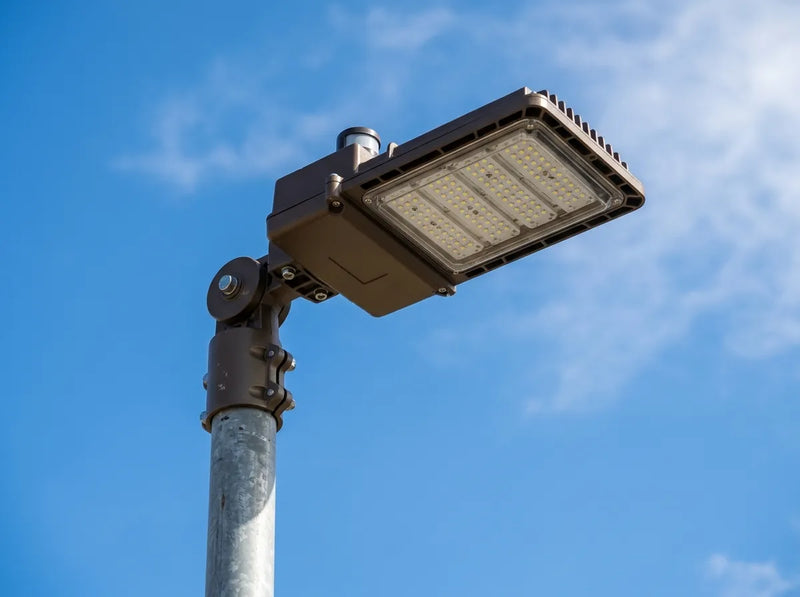
As a model-specific example, GGJIA's 400W adjustable-arm parking lot light lists 56,000 lumens, 5000K, AC 100–277V, IP66 and 0–10V dimming, with a 5-year warranty. Those specifications help you check compatibility; the site layout shows the resulting coverage. For wattage and mounting choices, see our parking lot light selection guide.
What Do You Need to Get Started?
- Mark the areas people use. Include parking rows, vehicle access, walking routes, entrances, drop-offs and neighboring homes.
- Collect the site information. Record the address, lot dimensions, pole positions and heights, supply voltage and operating hours. Add trees, buildings and tall vehicles that can block light.
- Confirm the criteria and get a layout. Ask the local authority or project reviewer for the adopted lighting requirements, including average/minimum levels, uniformity, spill light, height and controls. Professional guidance includes ANSI/IES RP-8; use the edition adopted or specified for your project.
- Check the installed result. Have light levels measured using the specified method, test controls and walk the lot after dark. Include required emergency and exit lighting in a separate power-outage check.

GGJIA offers free photometric layouts for any project size. Send your site dimensions, pole information and project location to support@ggjia-led.com to get started.
Related Reading
- How to Choose the Right LED Parking Lot Lights
- Metal Halide to LED Parking Lot Conversion: ROI and Project Costs
Sources
- Lighting Design Lab / Energy Trust of Oregon — Footcandle Lighting Guide (2013)
- Village of Germantown, Wisconsin — Lighting Guidelines
- City of Madison, Wisconsin — Outdoor Site and Building Lighting
- U.S. Department of Energy — Parking Lot Lighting Guide
- U.S. Department of Energy — Retailer Energy Alliance Working Group Presentation (2008)
- Pacific Northwest National Laboratory — Demonstration of LED Parking Lot Lighting (2011)
- Lighting Design Lab — Small Parking Lot LED Lighting Guide (2015)
- IES / International Dark-Sky Association — Model Lighting Ordinance (2011)
- Smithfield Township, Pennsylvania — Outdoor Lighting Requirements
- U.S. Department of Energy — Energy-Efficient Lighting (2021)
- DarkSky International — DarkSky Approved Luminaires Guidelines
- DesignLights Consortium — Solid-State Lighting FAQs
- Illuminating Engineering Society — Position on Outdoor Lighting Legislation and Ordinances
Frequently asked questions
How many foot-candles are required for a commercial parking lot?
What is the uniformity ratio for parking lot lighting?
What pole height is required for parking lot lights?
What BUG rating should parking lot lights have?
What color temperature is best for a parking lot?
How much light trespass is allowed at the property line?
Is DLC certification required for parking lot lights?

Find the right light for your space.
Explore GGJIA lighting, compare your options, and get help with your next project.
JOIN THE CONVERSATION
Leave a comment
READER DISCUSSION
Discussion
No comments yet. Be the first to share your thoughts.