





AT A GLANCE
Key Takeaways
- Parking lot lighting is governed primarily by IES RP-20 (specific) and referenced through IES RP-8 (roadway) in many municipal codes
- Footcandle minimums range from 0.5 fc (basic safety) to 5+ fc (high-activity retail) depending on facility type
- Uniformity ratio target: 4:1 maximum-to-minimum for basic safety; 3:1 for retail and high-traffic
- Pole height typically 20–30 ft, with fixture spacing roughly 4× mounting height
- BUG ratings (Backlight, Uplight, Glare) determine compliance with light pollution ordinances and dark-sky requirements
On this page
Why Parking Lot Photometric Layout Matters
Parking lot lighting carries higher legal exposure than almost any other commercial lighting application. Underlit parking lots are the location of approximately 80% of premises-liability lawsuits involving outdoor commercial property (per CLM Magazine industry surveys), and the most common defense — that the facility's lighting met the "standard of care" — depends entirely on documented compliance with IES recommendations.
A proper photometric layout produces three deliverables:
- A heat-map showing predicted footcandles at every point in the lot
- A uniformity ratio calculation (max-to-min) demonstrating even distribution
- A pole layout with fixture types, mounting heights and aiming angles
This guide walks through the design process the way an outdoor lighting designer approaches it, citing the relevant IES Recommended Practice documents and the BUG rating framework that determines compliance with light pollution ordinances.
Step 1: Identify the Applicable Standard

Three IES Recommended Practice documents apply to outdoor lighting:
- IES RP-20 Lighting for Parking Facilities — the primary standard for parking lots and parking structures, published 2014. This is the document to follow first.
- IES RP-8 Roadway Lighting — covers roads, but is referenced in many municipal codes for parking lot illumination because it predates RP-20 and is more familiar to local AHJs.
- IES TM-15 Luminaire Classification System (BUG Ratings) — defines the Backlight/Uplight/Glare ratings used for light pollution and dark-sky compliance.
Most U.S. municipal codes reference IES RP-8 by name. Where local codes contradict RP-20, follow local code; where local codes are silent, follow RP-20 as the more specific and current standard.
Step 2: Set Footcandle Targets by Facility Type
IES RP-20 publishes target illumination by parking facility classification:
| Facility Type | Average FC | Minimum FC | Uniformity Ratio (Max:Min) |
|---|---|---|---|
| Basic open parking (residential, low traffic) | 0.5 | 0.1 | 20:1 |
| Standard commercial parking | 1.0 | 0.2 | 15:1 |
| Enhanced security (multi-family, employee lots) | 2.0 | 0.5 | 10:1 |
| Active retail / restaurant | 2.4 | 0.6 | 4:1 |
| High activity (24-hour, dealership, transit hub) | 4.8 | 1.2 | 3:1 |
| Covered parking garage (interior) | 5.0 | 1.0 | 4:1 |
| Garage entrance/transition zone | 50+ daytime / 5+ nighttime | — | — |
Most U.S. commercial parking lots fall into the 1–5 fc range with a 4:1 uniformity ratio. The transition zone at a garage entrance is critical and often overlooked — the human eye takes 5–10 seconds to adapt from bright daylight to interior parking dimness, so the immediate entrance needs to be much brighter at noon than at midnight (most modern designs use a graduated lighting scheme with photocell control).

Step 3: Understand Uniformity Ratios
Average footcandles alone don't guarantee a safe lot. A lot that averages 2 fc but has dark patches at 0.2 fc is a tripping hazard. IES specifies uniformity ratios to prevent this.
Max-to-Min Ratio: The brightest point divided by the darkest point in the lot. Target ≤ 4:1 for safety, ≤ 3:1 for retail.
Avg-to-Min Ratio: The average illumination divided by the darkest point. Target ≤ 2:1 for most applications.
Why this matters in practice: A poorly designed lot with three 400W fixtures will have hot spots of 8–10 fc directly under the poles and dark spots of 0.5 fc between them — a 20:1 ratio that violates code. The same lot designed with six 200W fixtures will have 3 fc under the poles and 1.5 fc between — a 2:1 ratio that's easy on the eyes and code-compliant.
Step 4: Choose Mounting Height and Pole Spacing
Mounting height (the height of the fixture above the parking surface) determines both how much area each fixture can cover and how the light is distributed. The two are linked.
| Mounting Height | Typical Fixture Wattage | Approximate Pole Spacing | Best For |
|---|---|---|---|
| 15 ft | 100W–150W | 50–60 ft | Walkways, small lots, residential |
| 20 ft | 150W–200W | 70–90 ft | Small commercial lots, restaurant lots |
| 25 ft | 200W–300W | 90–110 ft | Standard commercial lots |
| 30 ft | 300W–400W | 110–130 ft | Large lots, dealerships, big-box retail |
| 35–40 ft | 400W+ | 130–150 ft | Industrial yards, freight, large retail |
A rule of thumb: pole spacing ≈ 4× mounting height. A 25-ft pole supports fixtures roughly 100 ft apart. Closer spacing produces hot spots; wider spacing produces dark patches.
Pole placement also matters relative to drive aisles and parking rows. The most common layouts are:
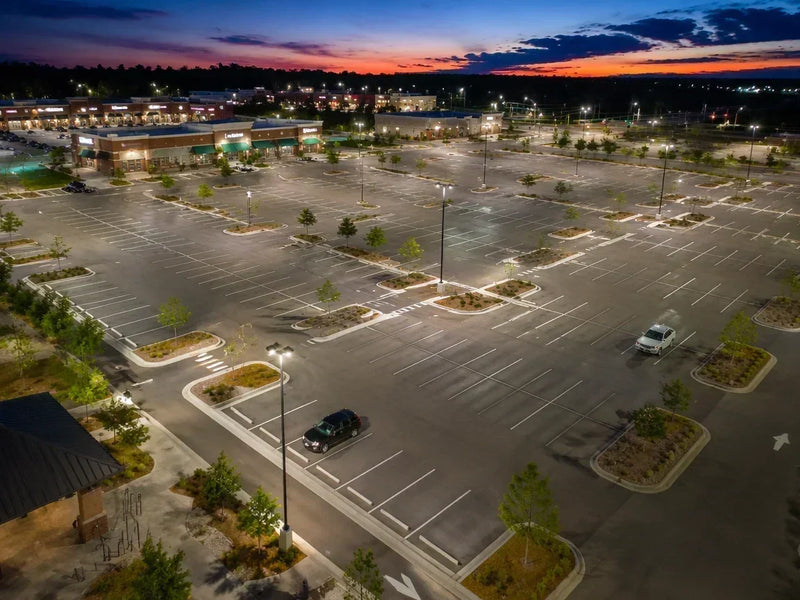
- Center-of-island: Pole on a concrete island between two rows of parking, distributes light to both rows. Most common in U.S. commercial lots.
- Perimeter: Poles on the property line, light directed inward. Used where center islands are impractical.
- Row-end: Poles at the end of each parking row. Less common, easier electrical infrastructure.
Step 5: Calculate Total Lumens by the Lumen Method
The same lumen-method formula used in warehouse design applies, with different parameters:
Total Lumens = (Area in sq ft × Target FC) ÷ (CU × LLF)
For parking lots:
- CU is typically 0.4–0.6 for outdoor area lighting (light spreads more freely outdoors than indoors, but loses to non-reflective ground and surrounding darkness)
- LLF = 0.75 for outdoor commercial (dirt accumulation is faster than indoors)
Worked Example
A 200-ft × 300-ft retail parking lot (60,000 sq ft) with active 24-hour traffic.
- Target: 2.4 fc avg
- CU = 0.5
- LLF = 0.75
Total Lumens = (60,000 × 2.4) ÷ (0.5 × 0.75)
= 144,000 ÷ 0.375
= 384,000 lumens
This lot needs roughly 384,000 lumens.
Using 200W LED parking lot fixtures (28,000 lumens each):
Fixture count = 384,000 ÷ 28,000 = ~14 fixtures
At 25-ft mounting height with 100-ft spacing, a layout of 4 pole rows × 3.5 poles per row (call it 4×4 = 16 poles for a margin) covers the lot uniformly.

Step 6: BUG Ratings and Dark-Sky Compliance
The BUG rating system (defined in IES TM-15) classifies how much light a fixture casts in three directions:
- B (Backlight) – light cast behind the fixture toward adjacent property. Scale: B0 (none) to B5 (maximum).
- U (Uplight) – light cast above the horizontal plane into the sky. Scale: U0 (none) to U5 (maximum).
- G (Glare) – high-angle light visible from public roadways. Scale: G0 (none) to G5 (maximum).
A typical "dark-sky compliant" specification is B2 U0 G2 or better — meaning low backlight, zero uplight, and low glare.
Light Pollution Ordinances
An increasing number of U.S. jurisdictions regulate outdoor lighting:
- Tucson, AZ and Flagstaff, AZ have some of the strictest dark-sky ordinances in North America
- Toronto, ON requires BUG rating compliance for new commercial installations
- Pittsburgh, PA and San Diego, CA have municipal lighting codes
- The entire state of Hawaii has light pollution restrictions in certain zones
- Many counties in Colorado, Utah and New Mexico have adopted IDA-compliant codes
Before specifying parking lot fixtures, check with your local AHJ for BUG-rating requirements. Even if not legally required, U0 (zero uplight) fixtures with house-side shields are increasingly expected by adjacent residential properties and may reduce nuisance complaints.
Full-Cutoff Fixtures
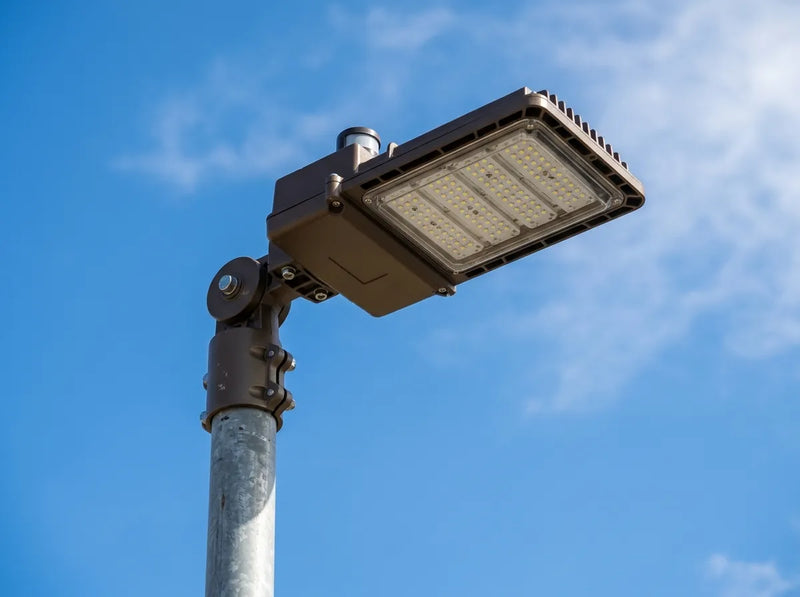
A "full-cutoff" fixture has BUG = U0 by design — no light is emitted above the horizontal plane. GGJIA's parking lot shoebox series and full-cutoff wall lights both meet U0 specifications when properly aimed.
Step 7: Photocell and Controls Strategy

Outdoor lighting wastes more energy through unnecessary daytime operation than through any other single factor. Photocell control alone reduces operating hours by approximately 50% across the year.
Photocell (Dusk-to-Dawn)
Each fixture (or a circuit-level controller) gets a small photocell that turns the lights on at dusk and off at dawn. Typical add: $15–$30 per fixture. Energy savings: ~50% of annual operating hours.
Motion Sensor Dimming
For perimeter and low-occupancy areas, fixtures dim to 30–50% in absence of motion, ramp to 100% when vehicles or pedestrians arrive. Energy savings: additional 30–50% on top of photocell control.
Time-Clock with BMS Integration
Large commercial properties tie outdoor lighting to a building management system, with scheduled on/off times overriding photocells. This integrates with demand-response programs offered by utilities.
Bi-Level / Step-Dim Configurations
Some facilities operate at 100% during business hours and dim to 30% from midnight to dawn for security-only lighting. Bi-level dimming saves an additional 30–40% on overnight hours.
Common Mistakes in Parking Lot Lighting
- Choosing wattage by old HPS/HID equivalence. A 400W metal halide produces roughly 36,000 lumens; the LED replacement is typically 200–240W, not 400W. Buying like-for-like wattage doubles the cost and creates over-illumination.
- Ignoring uniformity ratio. Average footcandles in spec but 10:1 max-to-min ratio still creates a dangerous lot.
- Mounting too high. A 40-ft pole reduces fixture count but produces less uniformity and more glare than two 25-ft poles. Higher isn't always better.
- Forgetting BUG compliance. A fixture that exceeds local light pollution ordinances may pass inspection but trigger neighbor complaints, code enforcement, or refused insurance claims for accidents on neighboring property.
- Skipping the photometric simulation. "Eyeball" layouts almost always produce uniformity ratios outside IES recommendations. A 2-day investment in DIALux or AGi32 simulation prevents 5–10 years of operational complaints.
Frequently asked questions
What's the minimum footcandle level for a commercial parking lot?
How tall should parking lot light poles be?
What's the difference between IES RP-8 and IES RP-20?
What BUG rating do I need for dark-sky compliance?
How much does a typical parking lot LED retrofit cost?
Do I need a permit to install new parking lot lighting?
Can I use one large fixture instead of multiple smaller ones?
How do I handle the parking lot lighting transition at a garage entrance?

Find the right light for your space.
Explore GGJIA lighting, compare your options, and get help with your next project.
JOIN THE CONVERSATION
Leave a comment
READER DISCUSSION
Discussion
No comments yet. Be the first to share your thoughts.