
ALL

News

What Is Needed For Warehouse Lighting Design?

I. Key Lighting Design Calculations (Practical Formulas)1. Lumen Method Formula (Determining Fixture Quantity)\[ N = \frac{E \times A}{\varphi \times U \times M} \] N: Number of fixtures E: Target illuminance (lux) A: Area (m²) ϕ: Luminous flux per fixture (lumens, e.g., 24,000 lm for a 200W LED) U: Utilization factor (0.4–0.8; lower for high-bay warehouses due to light loss) M:...

On 0 comments

Warehouse LED Lighting Standards And Regulations

Industry Standards and Regulations (Mandatory Compliance) OSHA Standards (USA) General industrial warehouse minimum illuminance: 20 lumens/sq.ft (200 Lux) (for aisles and non-precision work areas). Precision operation areas: Recommended ≥ 50 lumens/sq.ft (500 Lux). IESNA (Illuminating Engineering Society of North America) Standards Storage areas: 100 - 300 Lux (10 - 30 lumens/sq.ft). Sorting/packaging areas: 300 - 1000 Lux (30 - 100...

On 0 comments

How Does The Lighting Driver Work?

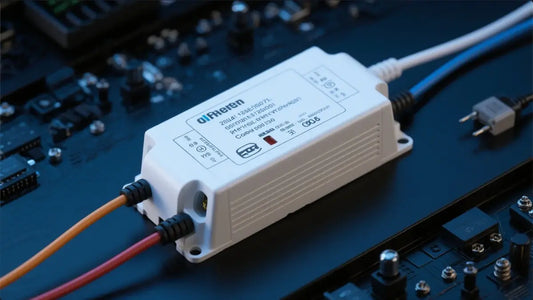
DefinitionA lighting driver is an electronic device used to control and regulate the power supply of lighting equipment, such as High Bay LED lights. It plays a crucial role in the lighting system, ensuring that the lighting equipment operates stably and efficiently.Working PrincipleIts main function is to convert the input power supply (such as alternating current) into an output power...

On 0 comments

What does 120 degree beam angle mean?

When shopping for LED lighting, you might notice terms like 120 degree beam angle. But what does beam angle mean, and why does it matter? For homeowners, DIY enthusiasts, and lighting buyers in the U.S., understanding light distribution is key to choosing the right fixture for your space. A 120 degree beam angle describes how widely a light spreads, impacting...

On 0 comments

Understanding the Spectrum and Colors of Visible Light

To comprehend light’s role in both natural phenomena and human applications, it is essential to explore the visible spectrum—the narrow band of electromagnetic radiation detectable by the human eye. While scientific interpretations of light’s interaction with human perception continue to evolve, established principles and properties provide a robust framework for understanding its nature. By analyzing diverse manifestations of light, from its...

On 0 comments

GGJIA Professional LED Lighting Solutions: Expanded Technical Specifications & Applications

GGJIA Professional LED Lighting Solutions: Expanded Technical Specifications & Applications Core 5A Advantages Across All Product Lines Adaptive Brightness (6,000–60,000 lumens) Anti-Glare Optics (UGR ≤19, 120°–270° beam angles) IP65 Weatherproofing (Dustproof, waterproof, -40°F to 122°F operation) 5-Year Warranty + 50,000–100,000-hour lifespan Smart-Ready Controls (0-10V/DALI/PIR motion sensors) Product Categories: In-Depth Breakdown 1. High Bay UFO Lights Power Range: 100W–400W Lumen Output: 11,000–60,000 lumens (150lm/W efficiency) Optics:...

On 0 comments

Optimizing LED Lighting in Functional Workspaces

Laboratories and warehouses, as crucial functional spaces, their lighting directly impacts work efficiency and safety. With advantages such as energy efficiency and high adaptability, LED technology has become an ideal choice for optimizing lighting in these spaces. This article will explore the key points of LED lighting design for laboratories and warehouses and explore how to enhance the efficiency of...

On 0 comments