ALL

News

Solving 6 Major Facility Pain Points with DLC-Certified Fixtures

When business owners think about energy efficiency, LED lighting is usually the first answer that comes to mind. But here is a critical question: Can a lighting solution designed for a dim, dusty warehouse simply be copied and pasted into a high-end retail store that relies on atmosphere? Absolutely not. The real challenge in modern facility management isn’t just “saving...

On 0 comments

The Ultimate Guide to UL, DLC, and ETL Standards

This Lighting Certifications Guide will demystify the regulations by dividing certifications into two critical buckets: Safety (NRTL: UL/ETL) and Performance (DLC). By the end of this guide, you will be able to specify products with confidence, ensure you never miss a rebate, and guarantee your installations pass every inspection.

On 0 comments

Is Daisy Chaining LED Lights Safe?

Introduction To illuminate large spaces such as garages, workshops, or warehouses, it is often necessary to use more than one light fixture. However, many old buildings lack the necessary power sockets to support rows of lights. This creates a dilemma: should you hire an electrician to install expensive new wiring, or run extension cords everywhere? There is actually a more...

On 0 comments

LED Lighting Fixtures Certification

Panoramic view of LED lighting product certification Certification Core role Applicable product types Market access value CE Legal sale in the European Union All LED lamps and driver power supplies The basic threshold for entering the European market DLC North American energy Efficiency subsidy Commercial LED industrial and mining lights, street lamps Obtain the procurement qualification of the government/power company...

On 0 comments

The development history of LED after Independence Day of the United States

Early Theories and Discoveries (Early 20th Century - 1960s) The 1950s: Breakthroughs in semiconductor research In the 1950s, research institutions such as Bell Labs in the United States began to conduct in-depth research on semiconductor materials, especially III-V group compound semiconductors (such as gallium arsenide GaAs and gallium phosphide GaP). These materials possess Electroluminescence (EL) properties, meaning they can emit...

On 0 comments

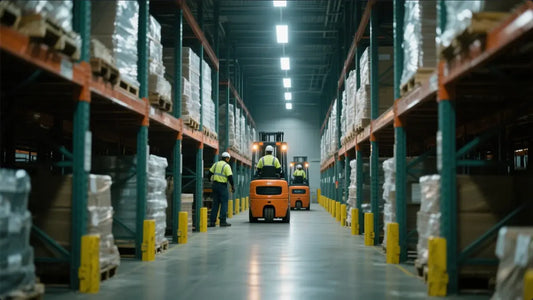
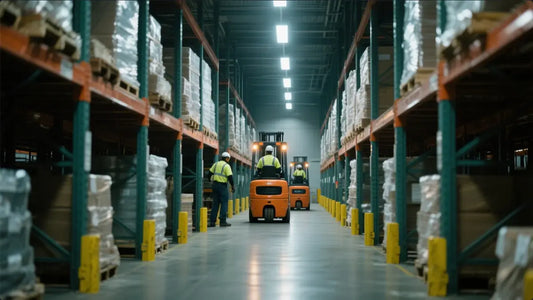
What Is Needed For Warehouse Lighting Design?

I. Key Lighting Design Calculations (Practical Formulas) 1. Lumen Method Formula (Determining Fixture Quantity) \[ N = \frac{E \times A}{\varphi \times U \times M} \] N: Number of fixtures E: Target illuminance (lux) A: Area (m²) ϕ: Luminous flux per fixture (lumens, e.g., 24,000 lm for a 200W LED) U: Utilization factor (0.4–0.8; lower for high-bay warehouses due to light...

On 0 comments

Warehouse LED Lighting Standards And Regulations

Industry Standards and Regulations (Mandatory Compliance) OSHA Standards (USA) General industrial warehouse minimum illuminance: 20 lumens/sq.ft (200 Lux) (for aisles and non-precision work areas). Precision operation areas: Recommended ≥ 50 lumens/sq.ft (500 Lux). IESNA (Illuminating Engineering Society of North America) Standards Storage areas: 100 - 300 Lux (10 - 30 lumens/sq.ft). Sorting/packaging areas: 300 - 1000 Lux (30 - 100...

On 0 comments